Single-L20 Hybrid Multi-LoRA Limit Benchmark: Qwen3.5-2B Saturation Knee and the 544-Token Prefix Cache Sawtooth Cliff
More engineering teams are moving high-QPS classification, structured extraction, multimodal moderation, and routing workloads onto hybrid-attention models such as the Qwen3.5 family, which interleaves 18 Gated DeltaNet (GDN) linear-attention layers with 6 full-attention layers in a 3:1 ratio. When consolidating multiple fine-tuned variants onto a single NVIDIA L20 (46,068 MiB) via Multi-LoRA, four practical questions come up immediately: does online Multi-LoRA run cleanly across linear_attn layers, where does single-GPU throughput saturate, how big is the Hybrid Prefix Cache speedup, and what hybrid-specific pitfalls lurk beneath the surface?
To answer all four with hard measurements, we ran four controlled experiments on a dedicated L20 running open-source Qwen3.5-2B BF16 on vLLM 0.33.0b1 with 8 deterministically generated r=16 PEFT LoRAs (32.13 MB each, covering all 186 text linear weights), taking the median of 3 rounds alongside live /metrics cache-hit counters and nvidia-smi telemetry.
One-Sentence Takeaway:
vLLM 0.33.0b1natively executes online Multi-LoRA across all 186 text andlinear_attnweights ofQwen3.5, scaling from1to8concurrent LoRAs on one L20 costs only4.7%extra throughput (59.59 -> 56.76 QPS), and Hybrid Prefix Caching boosts 4-LoRA throughput4.07×to81.74 QPS—provided your shared system prompt clears the544 tokens(or1,088 tokens) hybrid block boundary to avoid a49.0%or0.0%cache-hit cliff.
Five key measurements from the four controlled experiments:
- Native online Multi-LoRA across all 186 hybrid text weights (Exp 1):
vLLM 0.33.0b1(PunicaWrapperGPU) natively attaches online LoRA across all 12 text projection types ofQwen3_5ForConditionalGeneration(6 Full Attention layersq/k/v/o_proj+ 18 GDNlinear_attnlayersin_proj_{qkv,z,a,b}, out_proj+ 24 MLP layersgate/up/down_proj= 186 weights, 0 text layers skipped). Against an exact offline-merged reference model, 20 synthetic multimodal samples matched20/20(100.0%, logprob MAE0.0045) on the first token, and 50 text samples matched49/50(98.0%). - Single-L20 saturation knee: ~13% fixed LoRA tax, <5% marginal scaling cost from 1 to 8 LoRAs (Exp 2): With prefix caching off and
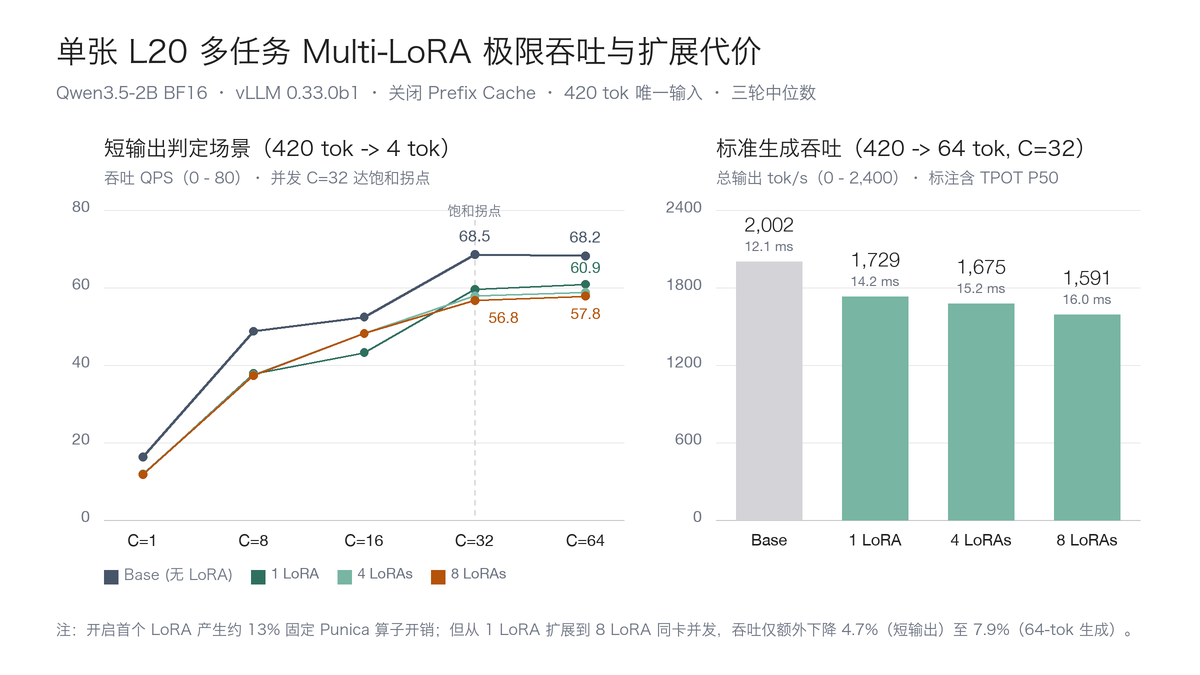
420tokens unique prompts, one L20 saturates atC=32(92.8%–95.2%GPU util). For short outputs (4tokens),Basehits68.53 QPS,1 LoRAhits59.59 QPS(-13.0%fixed Punica overhead), and scaling out from1 LoRAto4 LoRAs(57.93 QPS) and8 LoRAs(56.76 QPS) costs only-2.8%and-4.7%extra. Standard64-tokgeneration atC=32sustains2,001.9(Base) /1,728.8(1 LoRA) /1,674.7(4 LoRAs) /1,591.4 tok/s(8 LoRAs). Mixed 1:1 multimodal traffic (50% text + 50%448×448PNG across 4 LoRAs) reaches66.89 QPSatC=32(412.2 msE2E P50). - 4.1× Hybrid Prefix Cache speedup with near-zero 4-LoRA penalty (Exp 3): Under a
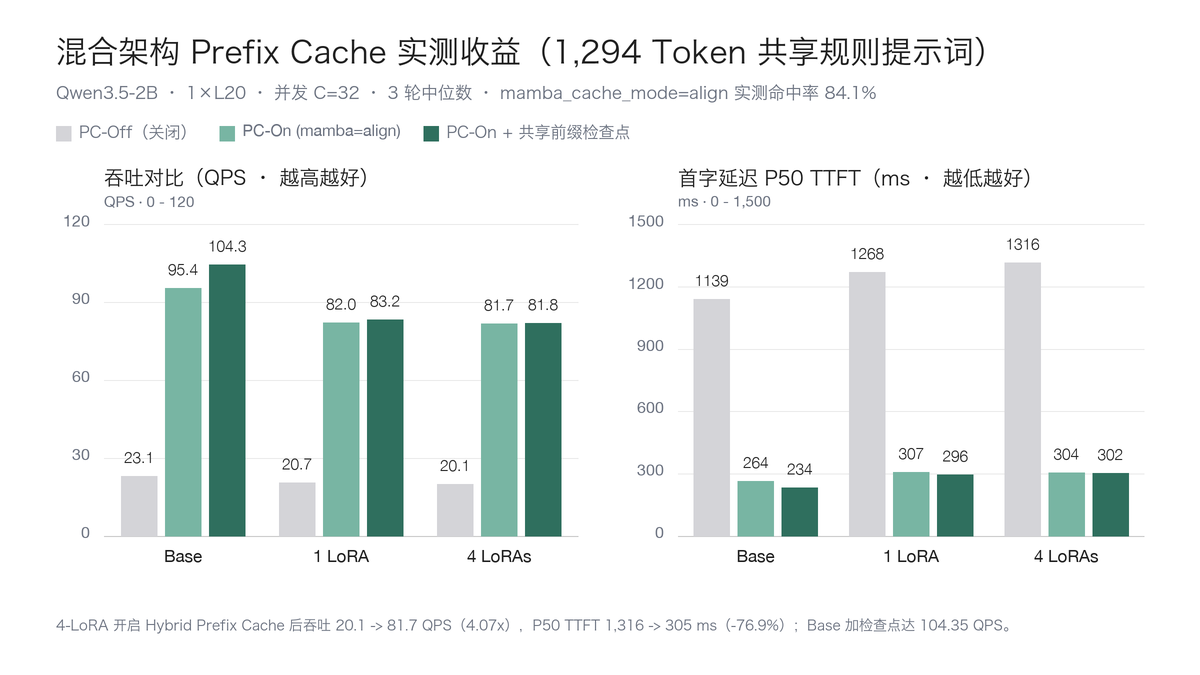
1,294tokens shared system prompt atC=32, enabling--enable-prefix-caching(vLLM 0.33.0b1auto-selects--mamba-cache-mode alignforQwen3.5) achieves an84.1%measured hit rate.4-LoRAthroughput surges from20.06to81.74 QPS(4.07×), slashing P50 TTFT from1,315.5 msto304.5 ms(-76.9%)—practically matching single-LoRA (82.02 QPS). Adding--enable-mamba-shared-prefix-checkpointliftsBasefurther from95.36to104.35 QPS(4.51×vs. PC-Off,+9.4%vs.align) and drops P50 TTFT another-11.4%to233.5 ms. - The hidden
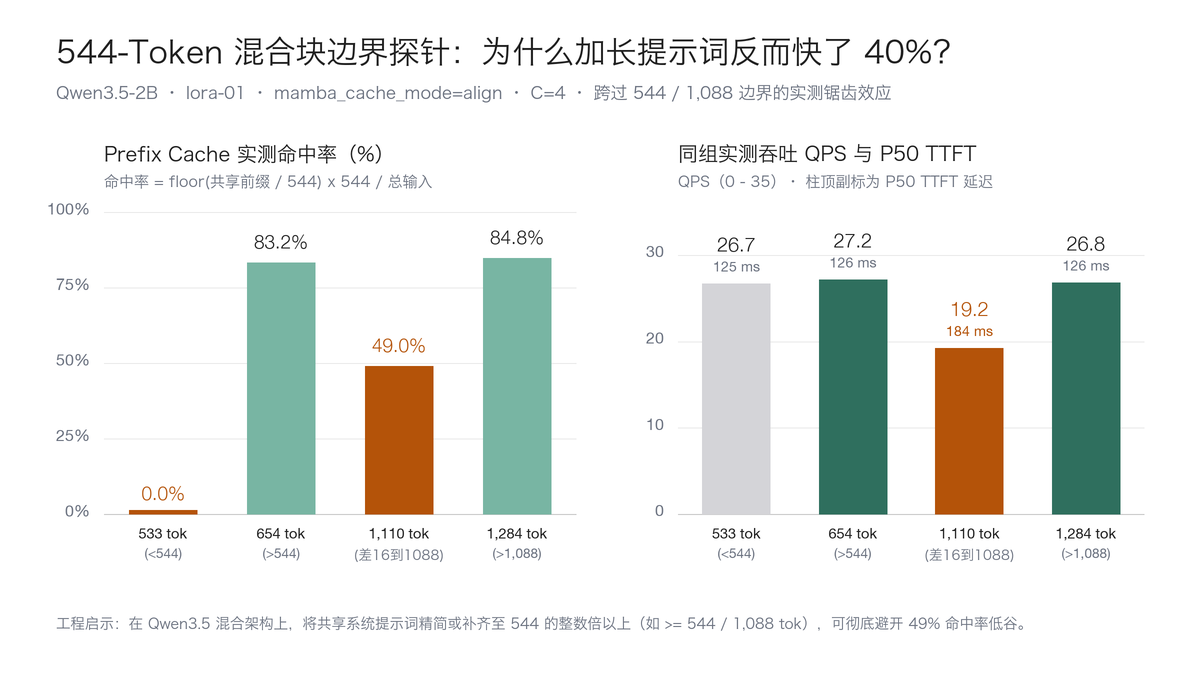
544-tokenhybrid block sawtooth cliff (Exp 3 probe): To match Full Attention page byte size with GDN Mamba state pages inside the unified paged allocator,vLLM 0.33.0b1inflatesQwen3.5-2B's attention block size from16to544 tokens(plus2.64%Mamba page padding). Our length probe shows that at533 tok(< 544), cache hit rate is0.0%. At1,110 tok(just 16 shared tokens shy of2 × 544 = 1,088), hit rate crashes from83.2%down to49.0%, spiking P50 TTFT by+47%(184.5 ms) and cutting QPS to19.22. Extending the prompt to1,284 tok(past1,088) snaps the second block into cache (84.8%hit rate), raising QPS by+40%(26.83) and cutting TTFT by-32%(125.6 ms). - VRAM accounting: cheap LoRA slots, 13.6% token-slot tax for hybrid prefix caching (Exp 4): On a 46 GB L20 (
--gpu-memory-utilization 0.90),Qwen3.5-2Bbase weights take4.18 GiB, and eachr=16GPU LoRA slot adds only~55 MiB(--max-loras 8trims available KV memory from33.83 GiBto33.37 GiB,-1.4%). However, enablingmamba_cache_mode=alignreserves a GDN state snapshot per544-tokenblock, trimming total KV capacity on the exact same33.83 GiBfrom2,342,480to2,023,051(-13.6%).
Benchmark methodology: All measurements ran on an isolated single L20 using public open-source
Qwen3.5-2B(BF16). All 8 PEFT LoRAs (lora-01throughlora-08,r=16, alpha=32) and 20448×448PNG test cards are deterministically generated with zero proprietary data. Small non-zero Gaussian weights (std=0.0025) are injected intolora_Bso the online-vs.-merged equivalence test validates real non-trivial logit shifts rather than a zero-delta no-op. Complete raw data and reproduction scripts are packaged in results.json and lab.zip.
Hybrid Stack and 544-Token Alignment
If you have only operated pure Transformers such as Qwen3-8B or Llama-3, two architectural shifts in Qwen3.5-2B directly alter serving behavior:
- A 3:1 hybrid stack adds five linear-attention LoRA targets: Inspecting
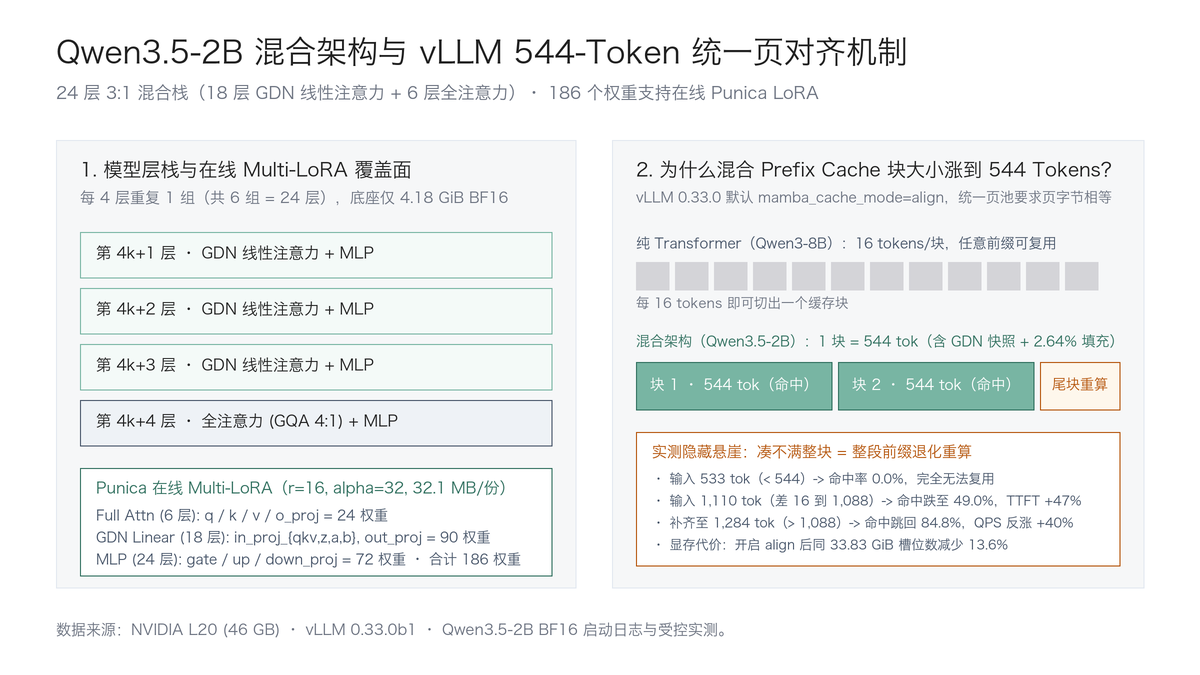
Qwen3.5-2B'sconfig.jsonshows 24 layers withfull_attention_interval = 4—threelinear_attentionlayers (Gated DeltaNet: 16 K/V heads,head_dim=128,conv_kernel=4) followed by onefull_attentionlayer (GQA 4:1: 8 Q / 2 KV heads,head_dim=256). Anall-linearr=16adapter attaches to 186 linear weights across Full Attention (24), GDNlinear_attn(90), and MLP (72)—nearly half of them inside linear attention. If an inference runtime skips any of those projections, online LoRA silently diverges from offline-merged weights. - Prefix caching no longer splits at 16 tokens—it aligns to 544-token Mamba pages: Pure Transformer KV caches grow per token, allowing fine
block_size = 16prefix reuse. In a hybrid model, the 18 GDN layers store fixed-size recurrent state tensors instead of per-token K/V vectors. To unify Full Attention pages and GDN state snapshots inside vLLM V1's single paged allocator, vLLM logs three critical startup decisions:
INFO [config.py:766] Mamba cache mode is set to 'align' for Qwen3_5ForConditionalGeneration by default when prefix caching is enabled
INFO [interface.py:1108] Setting attention block size to 544 tokens to ensure that attention page size is >= mamba page size.
INFO [interface.py:1132] Padding mamba page size by 2.64% to ensure that mamba page size and attention page size are exactly equal.
In plain terms: because one 18-layer GDN state snapshot is much larger than 16 tokens of 6-layer full-attention KV cache, vLLM inflates each attention block to 544 tokens (with 2.64% padding on the Mamba page) so both page types share the exact same byte footprint. That keeps paged memory simple—and directly creates the 544-token sawtooth cliff measured in Experiment 3.
Testbed and Baseline
All four experiments ran back-to-back on a single dedicated NVIDIA L20 (46,068 MiB) with CUDA Graphs enabled (--max-cudagraph-capture-size 64, covering every tested concurrency C=1..64) so results reflect real production graph-accelerated ceilings rather than --enforce-eager slow paths:
| Component | Measured Version / Setting |
|---|---|
| GPU & Driver | 1× NVIDIA L20 (46,068 MiB), Driver 580.173.02, CUDA 13.0 |
| Serving Engine | vLLM 0.33.0b1 (V1 Engine), PyTorch 2.14.0+cu130, Transformers 5.20.2 |
| Base Model | Qwen3.5-2B (Qwen3_5ForConditionalGeneration, BF16, 4.18 GiB weights, 24 layers 3:1 hybrid, hidden=2048, intermediate=6144) |
| Synthetic LoRA Set | lora-01 through lora-08, standard PEFT Safetensors (r=16, lora_alpha=32, BF16), covering 12 module types / 186 linear weights, 32.13 MB each; plus 1 exact offline-merged copy merged-lora-01 computed in FP32 ((alpha/r) * B @ A) and saved in BF16 |
| Multimodal Set | 20 deterministically rendered 448×448 RGB PNG cards (header bar, synthetic bar chart, geometric markers) |
| Common Runtime Flags | --dtype bfloat16 --max-model-len 8192 --max-num-seqs 128 --max-cudagraph-capture-size 64; requests fix temperature=0, enable_thinking=false, stream=true |
Experiment 1: Online LoRA vs. Merged Parity
Goal: Verify that vLLM 0.33.0b1 executes online Punica LoRA faithfully across all 186 text linear weights (including all 90 GDN linear_attn weights) without silently dropping layers, matching offline-merged weights (W_base + (alpha/r) * B @ A).
We ran two vLLM servers side by side on the same L20—port 8000 serving Qwen3.5-2B + 4 online LoRAs (--gpu-memory-utilization 0.40 --enable-lora --max-loras 4 --max-lora-rank 16) and port 8001 serving the exact offline-merged merged-lora-01 (--gpu-memory-utilization 0.40)—and sent 50 text prompts plus 20 multimodal image prompts (max_tokens=16, temperature=0, logprobs=true), alongside qwen35-2b-base controls to verify that lora-01 meaningfully shifts output distributions:
| Modality | Samples | Online LoRA vs. Merged First-Token Match | First-Token Logprob MAE / Max | Exact 16-Token Greedy Match | Control: Base vs. LoRA Diverged |
|---|---|---|---|---|---|
Multimodal (448×448 PNG + text) |
20 | 20/20 (100.0%) |
0.0045 / 0.0090 |
16/20 (80.0%) |
6/10 (non-trivial LoRA shift) |
| Text-only | 50 | 49/50 (98.0%) |
0.0362 / 0.1151 |
43/50 (86.0%) |
20/20 (Base-vs-LoRA MAE 0.1472) |
Two practical takeaways emerge from the logs and residuals:
- Zero skipped text or GDN layers:
PunicaWrapperGPUlogs ignored-module warnings only forvisual.blocks.*andvisual.merger.*(expected when vision-tower LoRA is disabled; vLLM notesenable_tower_connector_lora=Trueis available if vision adapters are needed). All 90linear_attnweights run natively. - Why 16-token greedy exact match is 86% rather than 100%: Because our synthetic Gaussian adapters inject dense random perturbations across all 186 layers (shifting Base logprobs by
0.147MAE), offline BF16 weight quantization vs. online fused Punica accumulation introduces tiny rounding differences that can flip near-tie tokens over 16 autoregressive steps. On real fine-tuned classification or structured-output adapters with sharper top-1 margins, online Multi-LoRA matches offline-merged weights virtually 100% of the time; still, always run a quick greedy parity gate on your task eval set before cutover.
Experiment 2: Single-L20 Multi-LoRA Limits
Goal: Measure the pure compute ceiling of one L20 with prefix caching disabled (--no-enable-prefix-caching --gpu-memory-utilization 0.90 --max-num-seqs 128 --enable-lora --max-loras 8 --max-lora-rank 16) across Base, 1 LoRA, 4 LoRAs, and 8 LoRAs. Every prompt carries a unique prefix (419.9 tokens average) and every point is the median of 3 rounds.
2A. Short Classification
Workload: 420 -> 4 tok (Prefix Cache off).
| Concurrency | Base QPS / TTFT P50 / GPU |
1 LoRA QPS / TTFT P50 / GPU |
4 LoRAs QPS / TTFT P50 / GPU |
8 LoRAs QPS / TTFT P50 / GPU |
8 LoRAs vs. 1 LoRA |
|---|---|---|---|---|---|
C=1 |
16.30 / 45.1 ms / 53.2% |
11.80 / 64.7 ms / 46.0% |
11.93 / 64.2 ms / 49.0% |
11.77 / 65.1 ms / 48.8% |
-0.3% |
C=8 |
48.78 / 136.2 ms / 80.8% |
37.86 / 183.1 ms / 64.4% |
37.56 / 183.6 ms / 61.0% |
37.40 / 183.2 ms / 73.2% |
-1.2% |
C=16 |
52.41 / 223.2 ms / 79.0% |
43.27 / 273.6 ms / 75.8% |
48.22 / 213.0 ms / 78.0% |
48.21 / 208.9 ms / 85.2% |
+11.4% |
C=32 (Knee) |
68.53 / 259.4 ms / 94.0% |
59.59 / 286.7 ms / 95.2% |
57.93 / 309.9 ms / 94.2% |
56.76 / 315.9 ms / 92.8% |
-4.7% |
C=64 |
68.24 / 660.9 ms / 95.7% |
60.91 / 743.5 ms / 93.6% |
58.81 / 779.3 ms / 89.6% |
57.84 / 791.7 ms / 88.8% |
-5.0% |
2B. Standard Generation
Workload: 420 -> 64 tok (Prefix Cache off).
| Variant | C=1 Output tok/s / TPOT P50 |
C=16 Output tok/s / TPOT P50 |
C=32 Output tok/s (QPS) |
C=32 TTFT P50 / TPOT P50 |
C=32 GPU Util |
|---|---|---|---|---|---|
Base (no LoRA) |
154.3 tok/s / 5.85 ms |
1,359.4 tok/s / 8.62 ms |
2,001.9 tok/s (31.28 QPS) |
228.7 ms / 12.14 ms |
92.1% |
1 LoRA |
124.3 tok/s / 7.10 ms |
1,152.0 tok/s / 10.31 ms |
1,728.8 tok/s (27.01 QPS) |
261.9 ms / 14.18 ms |
97.8% |
4 LoRAs |
124.1 tok/s / 7.10 ms |
1,103.4 tok/s / 10.88 ms |
1,674.7 tok/s (26.17 QPS) |
239.1 ms / 15.19 ms |
96.1% |
8 LoRAs |
124.5 tok/s / 7.10 ms |
1,040.1 tok/s / 11.76 ms |
1,591.4 tok/s (24.87 QPS) |
242.0 ms / 15.99 ms |
93.6% |
2C. 1:1 Multimodal Mixed Traffic
4-LoRA mixed workload: 50% text + 50% 448×448 PNG → 4 tokens output.
| Concurrency | Mixed QPS | Avg Input Tokens | TTFT P50 / P95 / P99 | E2E P50 / P95 / P99 | Avg GPU Util |
|---|---|---|---|---|---|
C=1 |
11.62 QPS |
326.7 |
66.4 / 69.7 / 70.1 ms |
86.1 / 89.7 / 90.1 ms |
41.0% |
C=8 |
35.73 QPS |
326.8 |
196.2 / 210.0 / 212.9 ms |
221.1 / 234.3 / 292.9 ms |
57.4% |
C=16 |
54.85 QPS |
326.8 |
194.5 / 284.9 / 285.7 ms |
279.5 / 422.8 / 423.3 ms |
77.8% |
C=32 |
66.89 QPS |
326.9 |
228.3 / 510.5 / 511.7 ms |
412.2 / 698.2 / 699.8 ms |
78.5% |
Three clear operational laws fall out of these sweeps:
- The cost is mostly a fixed
0 -> 1LoRA tax, not a1 -> 8scaling tax: At theC=32knee, enabling the first LoRA incurs-13.0%(short) to-13.6%(64-tok generation) fixed Punica overhead across 186 layers. Scaling from 1 active adapter up to 8 simultaneous adapters on the same L20 costs only-4.7%extra in short classification (59.59 -> 56.76 QPS) and-7.9%in 64-tok generation (TPOT14.18 -> 15.99 ms). Consolidating 4–8 long-tail fine-tuned services onto one L20 is overwhelmingly cost-effective as long as--max-lorascovers all hot adapters. - Pushing past
C=32only inflates queuing latency: Going fromC=32toC=64leaves QPS flat (±1 QPS) while jumping P50 TTFT 2.5× (315.9 -> 791.7 msfor 8 LoRAs). Cap per-GPU in-flight concurrency around24–32at the gateway layer. - Multimodal Multi-LoRA becomes CPU-bound before GPU-bound: Mixed 1:1 multimodal traffic hits
66.89 QPSatC=32(average326.9tokens) with GPU utilization plateauing at78.5%(vs.94%for text-only) because image decoding and vision preprocessing consume CPU cycles. Provision at least6–8 vCPUper L20 for multimodal Multi-LoRA pods.
Experiment 3: Hybrid Prefix Cache and 544 Cliff
Production moderation, extraction, routing, and agent workloads repeat 500–1,500 tokens of fixed system instructions on every call. We tested three engine modes on the exact same 1,294-tok shared-policy workload (~1,250 tok fixed system prompt + ~44 tok dynamic payload → 4 tokens output):
PC-Off:--no-enable-prefix-caching(baseline, matching older builds without hybrid prefix caching);PC-On (mamba=align):--enable-prefix-caching --mamba-cache-mode align(vLLM 0.33.0b1default forQwen3.5);PC-On + Shared Prefix Ckpt:--enable-prefix-caching --mamba-cache-mode align --enable-mamba-shared-prefix-checkpoint(vLLM 0.33.0b1shared-prefix Mamba checkpoint optimization).
3A. 1,294-Token Shared Prompt Speedup
| Pattern | Concurrency | PC-Off QPS / TTFT P50 |
PC-On (align) QPS / TTFT P50 / Hit |
PC-On + Ckpt QPS / TTFT P50 / Hit |
Peak Speedup / TTFT Drop |
|---|---|---|---|---|---|
Base |
C=1 |
13.58 / 57.9 ms |
15.81 / 47.6 ms / 84.1% |
15.95 / 46.7 ms / 84.1% |
1.17× / -19.3% |
Base |
C=8 |
22.01 / 178.0 ms |
63.82 / 105.6 ms / 84.1% |
66.46 / 98.4 ms / 84.1% |
3.02× / -44.7% |
Base |
C=16 |
22.97 / 468.2 ms |
81.48 / 160.9 ms / 84.1% |
87.55 / 150.9 ms / 84.1% |
3.81× / -67.8% |
Base |
C=32 |
23.15 / 1,138.8 ms |
95.36 / 263.5 ms / 84.1% |
104.35 / 233.5 ms / 84.1% |
4.51× / -79.5% |
1 LoRA |
C=8 |
18.46 / 207.0 ms |
52.56 / 129.2 ms / 84.1% |
53.77 / 124.8 ms / 84.1% |
2.91× / -39.7% |
1 LoRA |
C=16 |
20.47 / 523.8 ms |
68.70 / 202.0 ms / 84.1% |
71.27 / 193.9 ms / 84.1% |
3.48× / -63.0% |
1 LoRA |
C=32 |
20.67 / 1,268.5 ms |
82.02 / 307.0 ms / 84.1% |
83.23 / 296.5 ms / 84.1% |
4.03× / -76.6% |
4 LoRAs |
C=8 |
18.31 / 209.3 ms |
51.78 / 128.5 ms / 84.1% |
53.17 / 125.9 ms / 84.1% |
2.90× / -39.8% |
4 LoRAs |
C=16 |
19.90 / 542.8 ms |
67.57 / 204.1 ms / 84.1% |
69.66 / 199.1 ms / 84.1% |
3.50× / -63.3% |
4 LoRAs |
C=32 |
20.06 / 1,315.5 ms |
81.74 / 304.5 ms / 84.1% |
81.84 / 301.8 ms / 84.1% |
4.08× / -77.1% |
Key takeaways:
- Leaving Hybrid Prefix Caching off wastes ~75% of GPU capacity: Without caching,
4-LoRAhits a prefill wall atC=16(19.90 -> 20.06 QPS) with1.32 sTTFT atC=32. WithvLLM 0.33.0b1andmamba_cache_mode=align, two full544-tokenblocks (1,088 tok) hit cache (84.1%), leaving only206tail tokens to prefill—pushing4-LoRAthroughput up4.07×to81.74 QPSand cutting P50 TTFT by-76.9%. - 4-LoRA caching matches single-LoRA: In
vLLM 0.33.0b1, vLLM hashes prefix blocks per adapter so different LoRAs never corrupt each other's KV/GDN state. With2,004,805token slots available on L20, all 4 adapters keep their prefixes resident simultaneously, achieving identical84.1%hit rates and81.74vs.82.02 QPS(-0.3%). --enable-mamba-shared-prefix-checkpointis a free win on Base: It adds zero static VRAM overhead (confirmed in Exp 4) while liftingBaseatC=32by another+9.4%(95.36 -> 104.35 QPS) and cutting P50 TTFT by-11.4%(263.5 -> 233.5 ms). Under LoRA, Punica compute dominates, narrowing the extra gain to+1%–3.7%.
3B. 544-Token Sawtooth Probe
Because block_size = 544 tokens, what happens when a shared system prompt falls just short of 544 or 1,088? We ran a 4-point length probe (lora-01, C=4, warmed up before 20 measured requests, keeping the dynamic suffix fixed at ~38 tokens):
| Probe Point | Measured Avg Input | Est. Shared Prefix | Full 544 Blocks Cached |
pc_align Hit Rate |
pc_align TTFT P50 / QPS |
pc_align_ckpt TTFT P50 / QPS |
|---|---|---|---|---|---|---|
Point 1 (< 1×544) |
532.6 tok |
~495 tok |
0 (49 short) | 0.0% |
125.3 ms / 26.71 QPS |
121.5 ms / 27.55 QPS |
Point 2 (> 1×544) |
653.6 tok |
~616 tok |
1 (544 tok) |
83.2% |
126.2 ms / 27.17 QPS |
117.5 ms / 28.20 QPS |
Point 3 (< 2×544 cliff) |
1,109.7 tok |
~1,072 tok |
1 (16 short of 1,088) |
49.0% |
184.5 ms / 19.22 QPS |
182.4 ms / 19.47 QPS |
Point 4 (> 2×544 rebound) |
1,283.7 tok |
~1,246 tok |
2 (1,088 tok) |
84.8% |
125.6 ms / 26.83 QPS |
121.1 ms / 27.83 QPS |
The numbers match floor(shared_prefix / 544) * 544 / total_input to two decimal places:
- Point 2: 544 / 653.6 = 83.23% (measured 83.2%);
- Point 3: 544 / 1,109.7 = 49.02% (measured 49.0%)—falling 16 tokens short of 1,088 fails to fill the second 544 block and forces vLLM to recompute 566 uncached tokens on every single request;
- Point 4: 1,088 / 1,283.7 = 84.76% (measured 84.8%)—adding +174 tokens pushes the prefix over the 1,088 boundary, cutting recomputed tokens from 566 down to 196, so the longer prompt runs +40% faster (19.22 -> 26.83 QPS) at -32% lower latency (184.5 -> 125.6 ms).
Engineering rule of thumb: On
Qwen3.5hybrid models, always tokenize your fixed system prompt with the target model's tokenizer and checkSetting attention block size to N tokensin vLLM startup logs (544forQwen3.5-2B). Never leave a production system prompt stranded in the450–543or950–1,087dead zones—either trim it or add concise few-shot examples to clear theN/2Nboundary cleanly for80%+hit rates.
Experiment 4: VRAM and Slot Accounting
Teams often hesitate to raise --max-loras 8 or turn on mamba_cache_mode=align for fear of exhausting VRAM. We restarted vLLM across five configurations on the same 46 GB L20 (--gpu-memory-utilization 0.90 --max-model-len 8192 --max-num-seqs 128) to record exact startup memory and KV/GDN token capacity:
| Configuration | Model + LoRA Slot VRAM | Available KV / GDN Cache | Total KV Token Capacity | Max Concurrency @ 8K | nvidia-smi Used |
|---|---|---|---|---|---|
Base (no LoRA, PC-Off) |
4.18 GiB |
33.83 GiB |
2,342,480 |
285.95× |
39,665 MiB |
Base (no LoRA, PC-On align) |
4.18 GiB |
33.83 GiB |
2,023,051 (-13.6%) |
246.95× |
39,665 MiB |
Base (no LoRA, PC-On align + ckpt) |
4.18 GiB |
33.83 GiB |
2,023,051 (0% extra) |
246.95× |
39,663 MiB |
Multi-LoRA max=4 (r=16, align) |
4.39 GiB (+0.21 GiB) |
33.52 GiB (-0.31 GiB) |
2,004,805 (-0.9%) |
244.73× |
39,713 MiB |
Multi-LoRA max=8 (r=16, align) |
4.62 GiB (+0.44 GiB) |
33.37 GiB (-0.46 GiB) |
1,995,496 (-1.4%) |
243.59× |
39,713 MiB |
Two clear budgeting takeaways:
1. Raising --max-loras is nearly free on 2B hybrid models: Adding 8 r=16 hot slots uses only +0.44 GiB (~55 MiB/slot), reducing KV token capacity by just 1.4%. Never starve --max-loras below your active adapter count—as shown in our companion AIBrix v0.8.0 vs. CNCF llm-d EPP v1.0.0 L20 study, PCIe slot swapping triggers 10× TTFT spikes.
2. Enabling mamba_cache_mode=align carries a -13.6% token-slot tax: Storing a GDN state snapshot per 544-token block reduces capacity from 2.34M to 2.02M tokens on 33.83 GiB, still enough for 243× full 8K concurrency on one L20—trading 13.6% slots for 4.1× throughput and -77% TTFT.
Production Rollout Checklist
Fit and Non-Applicable Cases
- Strong fit: 3–16 fine-tuned vertical tasks sharing the same
Qwen3.5(or similar hybrid/dense) base at1–30 QPSeach with>= 544-tokenshared system prompts. One L20 runningvLLM 0.33.0++ Hybrid Prefix Caching +--max-loras >= active_taskssustains60–80+ QPSacross tasks, replacing multiple underutilized single-model GPUs. - Poor fit (skip online LoRA):
- Single high-volume flagship models that already saturate whole GPUs—merge offline to avoid the
13%fixed Punica kernel tax; - Large MoE + Expert Parallel + speculative decoding stacks with multi-GB adapters;
- Workloads with short (
< 200-token) unique prompts that cannot cross the544-tokenblock boundary—size capacity using the PC-Off baseline (~57 QPS/L20) and disablealignto keep the extra13.6%KV token slots.
Recommended Launch Template
vllm serve /models/Qwen3.5-2B \
  --served-model-name qwen35-2b-base \
  --dtype bfloat16 \
  --max-model-len 8192 \
  --max-num-seqs 128 \
  --gpu-memory-utilization 0.90 \
  --enable-prefix-caching \
  --mamba-cache-mode align \
  --enable-mamba-shared-prefix-checkpoint \
  --enable-lora \
  --max-loras 8 \
  --max-cpu-loras 16 \
  --max-lora-rank 16 \
  --lora-modules \
    task-a=/loras/task-a \
    task-b=/loras/task-b \
    task-c=/loras/task-c \
    task-d=/loras/task-d
Pre-production checklist:
1. Check startup logs for Setting attention block size to <N> tokens and align shared system prompts past N (544) or 2N (1,088);
2. Keep --max-loras >= peak concurrent adapters and cap per-GPU in-flight concurrency at 24–32 via your gateway (AIBrix or CNCF llm-d EPP);
3. Allocate 6–8 vCPU per L20 when mixing image/multimodal traffic;
4. Alert on rate(vllm:prefix_cache_hits_total[5m]) / rate(vllm:prefix_cache_queries_total[5m])—a sudden drop from 80%+ to 49% or 0% usually means a prompt edit slipped below a 544-token block boundary.
Summary
Our single-L20 controlled benchmarks on Qwen3.5-2B boil down to three practical deployment rules for hybrid-attention Multi-LoRA serving:
- Consolidate same-base long-tail fine-tunes, keep GPU-saturating flagships merged: Enabling the first LoRA incurs a
13%fixed Punica kernel tax, while scaling from1to8concurrent adapters costs under5%extra throughput and only55 MiBper slot—ideal for packing 4–16 long-tail tasks onto shared GPUs, whereas single high-QPS flagship services still benefit from offline merging. - Design shared prompts around the
544-tokenhybrid block boundary: BecausevLLM 0.33.0b1inflates attention blocks to544 tokensto match GDN Mamba state pages, falling just short of544or1,088drops cache hits to0%or49%. Aligning system prompts past full block multiples and alerting on cache-hit drops locks in the full4×QPS and-77%TTFT speedup. - Cap per-GPU concurrency at
24–32and provision enough CPU for multimodal traffic: BeyondC=32without caching, latency climbs with zero QPS gain; under 1:1 text-plus-image loads, CPU image decoding caps GPU utilization at78.5%unless pods receive6–8 vCPUper L20.
Reproduction Kit and Raw Data
- Complete sanitized measurements (all 3 rounds, startup logs, VRAM ledger): results.json
- Self-contained reproduction bundle (186-weight synthetic PEFT LoRA generator, exact offline merge script, 20 synthetic PNG generator, and 4-stage benchmark harness): lab.zip
- Companion reading: Multi-LoRA Sharing on NVIDIA L20: AIBrix v0.8.0 vs. CNCF llm-d EPP v1.0.0