DeepSeek Super-agent Analysis: From Chat Sessions to a Team Task System
DeepSeek's newly public dsh-superagent-prototype raises a question beyond model capability: when agents handle several tasks for a team, how can the system reduce the time people spend watching sessions, moving context, chasing progress and recovering from failures? GitHub records the repository's creation on October 31, 2026, and its initial commit used here is dated the same day. Neither date is a formal product release date. Source: repository metadata
The project's value lies in connecting a coding agent to ongoing teamwork. It reads GitHub and optional Feishu events, determines which requests may initiate work, creates traceable tasks, dispatches them to separate sessions and returns results to the original discussion. It provides neither new model weights nor faster model inference.
The official README calls it a research prototype. It explicitly distinguishes the published code from the internal implementation and design article, with some ideas not yet implemented. It should therefore be treated as a system design to study, validate and adapt, rather than a mature enterprise digital employee product. The project uses the MIT license. This analysis uses commit 6337fc823ce20251c8de8085948165c81aaa701e, reviewed as of November 1, 2026. Source: official README
1. How it relates to DeepSeek Harness
DeepSeek Harness, whose command is dsh, provides the foundations: agent sessions, model integration, tools, permissions, persistence and Web interaction. Super-agent adds the lifecycle of team tasks. It is installed as a Bundle—a collection of plugins and configuration—inside a dedicated Harness Profile, or runtime configuration.
| Layer | Responsibility | Super-agent's position |
|---|---|---|
| Models and inference services | Inference for content generation and tool use | Uses a configured model service |
| DeepSeek Harness | Sessions, tool execution, context and runtime | Hosts the main session and task execution sessions |
| Super-agent | Events, admission, authorization, tasks, dispatch and replies | The core of this project |
| Code and collaboration systems | GitHub Issues, pull requests and Feishu discussions | Receive work, provide context and carry results |
| Operating system and sandbox | Process, file, credential and resource isolation | Must be designed by the operator; a work directory is not an isolation boundary |
The current prototype serves one GitHub repository, with Feishu as an optional entry point. It is neither a ready-made workflow platform for arbitrary business processes nor a general enterprise scheduler spanning many repositories. For the underlying runtime, see the existing Harness repository analysis. Source: project description and deployment documentation
2. The key change is giving work its own identity
A conventional single session often puts requirements, execution, follow-ups and failures into one context. Super-agent separates the records for a message arriving, the authority it grants and the executor currently doing the work.
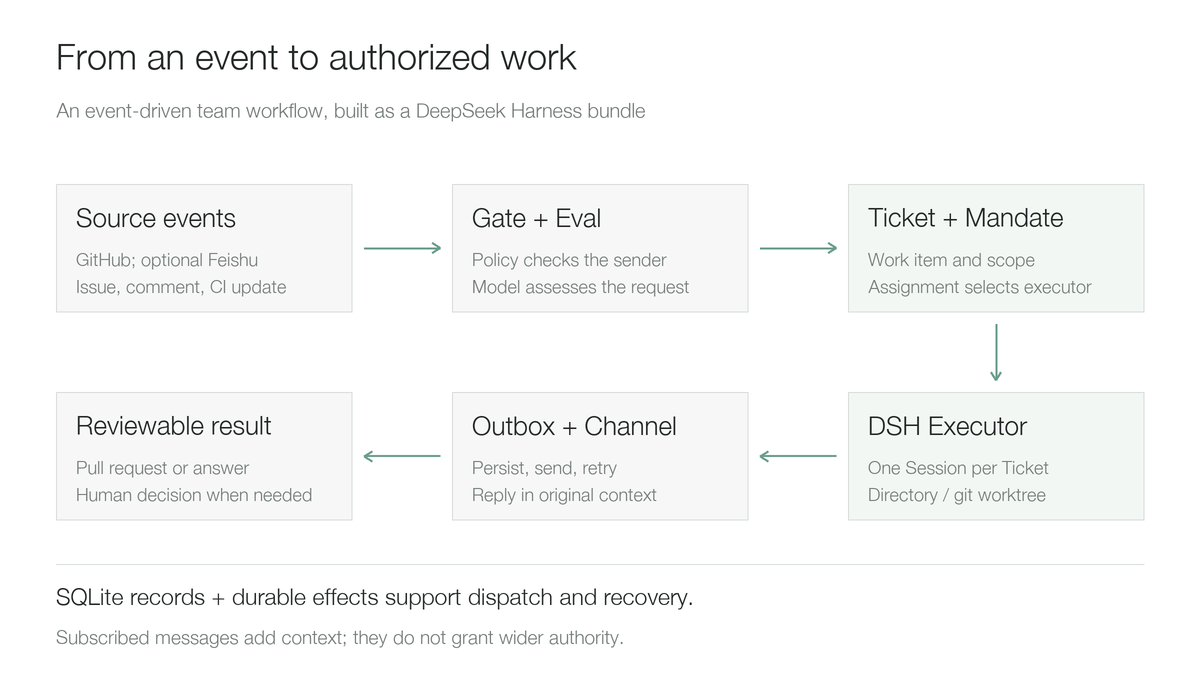
Figure 1: A simplified flow based on the official domain model. The terms correspond to the table below. This is an architecture diagram, not a deployment screenshot. Subscribed messages can add context without expanding authorization.
| Concept | Meaning | Problem it addresses |
|---|---|---|
| Source / Trigger | An event source / one immutable event | Treating a repeated poll as new work |
| Thread | An ongoing discussion, evaluated sequentially within that thread | Conflicting context and judgements about the same discussion |
| Eval / Policy | Request evaluation / versioned admission rules | Executing any text that happens to be visible |
| Mandate | The authorized scope and basis recorded when work is accepted | Allowing later context to silently expand the original task |
| Ticket | A work item with its own lifecycle | Equating task state with the state of a model call |
| Assignment / Executor | One dispatch / the component executing it | Losing ownership of work when an executor restarts |
| Subscription | A relationship between a task and a discussion | Requiring people to forward follow-up discussion and continuous integration results |
| Channel / Outbox | A reply channel / durable outgoing messages | Finishing work without reliably returning its result |
For example, an Issue asking the agent to fix a parsing error and add a regression test can create a Ticket whose scope covers that repair. The executor changes code in its own directory and opens a Pull Request (PR). Continuous Integration (CI) failures and review comments continue to reach the task. A later request to redesign a different system should be routed and assessed for scope; its presence in the same discussion does not automatically authorize it.
A Thread may have several Tickets, and a Ticket may have successive Assignments. This is more than creating one subagent per message. Source: domain model
3. How proactive behavior is constrained
Admission first checks the source, sender identity and whether the agent is being directly asked to work. The model then assesses the request. Subscribed discussions take another path: their messages can become context for existing tasks, but do not grant additional authority.
For proactive work inferred from written rules, the system offers three accept modes:
| Mode | Behavior for inferred work | Appropriate stage |
|---|---|---|
off |
Does not produce inferred candidates | Handle explicit requests only |
observe |
Assesses and records “would accept” without accepting work | Check rules for false triggers; this is the default |
auto |
Accepts work after a rule matches and assessment passes | Enable proactive work within a limited scope |
These modes are not the agent's global on/off switch. Valid explicit requests work in all three modes. Changing auto to off does not establish that every execution has stopped.
Three operational details also matter:
- A Policy version change invalidates ongoing evaluations and queues them again. It does not immediately revoke all running tasks; affected tasks receive a policy-change input.
- Pausing processing stops new evaluations, dispatch, input delivery and replies. Sources continue recording events, and an active turn is not directly interrupted.
- Stopping a Ticket in the panel is a different control path from having the model interpret a stop request in a discussion.
My assessment is that observe is a better starting point than immediately enabling proactive execution: inspect false accepts and noise before widening scope. Emergency permission withdrawal should also use deterministic stop controls and underlying credential controls, rather than depending only on the model understanding a new rule in time. Source: authorization and control semantics
4. What parallel execution does and does not solve
The main session assesses, routes and coordinates. Each Ticket has a separate executor session and directory. A prepare command can create a checkout using git worktree, allowing independent tasks to advance concurrently without repeatedly changing branches in a shared working directory.
Several execution details are useful design references:
- Capacity is reserved before launch or wake-up, preventing simultaneous asynchronous starts from taking the last slot twice.
- A human follow-up may use one extra slot beyond
maxWorkers, with priority over new tasks. This reduces the chance that new work prevents a person from correcting existing work. - When a turn ends with Shell jobs or subagents still running, the task keeps its slot. Handoff for human review or an answer releases capacity according to the execution rules.
- Foreground commands move to background jobs after 5 seconds by default, allowing the executor to receive input instead of waiting for a long command to finish.
These choices improve task responsiveness and scheduling. They do not automatically accelerate an individual model inference. Separate worktrees also cannot remove logical conflicts when tasks change the same public interface; integration tests and code review remain necessary.
Moreover, maxWorkers is not a global model API concurrency limit. The main session, assessment, executor sessions and subtasks may all consume model resources. Deployment should therefore also enforce concurrency, rate and budget limits at the model gateway. This is a capacity recommendation inferred from the execution structure, rather than a claim that the prototype already provides comprehensive billing governance. Sources: execution documentation, WorkerSlots implementation
5. What supports interruption and resume
The prototype stores work records in SQLite and uses a durable Effects queue for dispatch, input delivery, replies and other subsequent actions. Recording intent before carrying out an outside action helps avoid the lost work associated with an in-memory queue after restart.
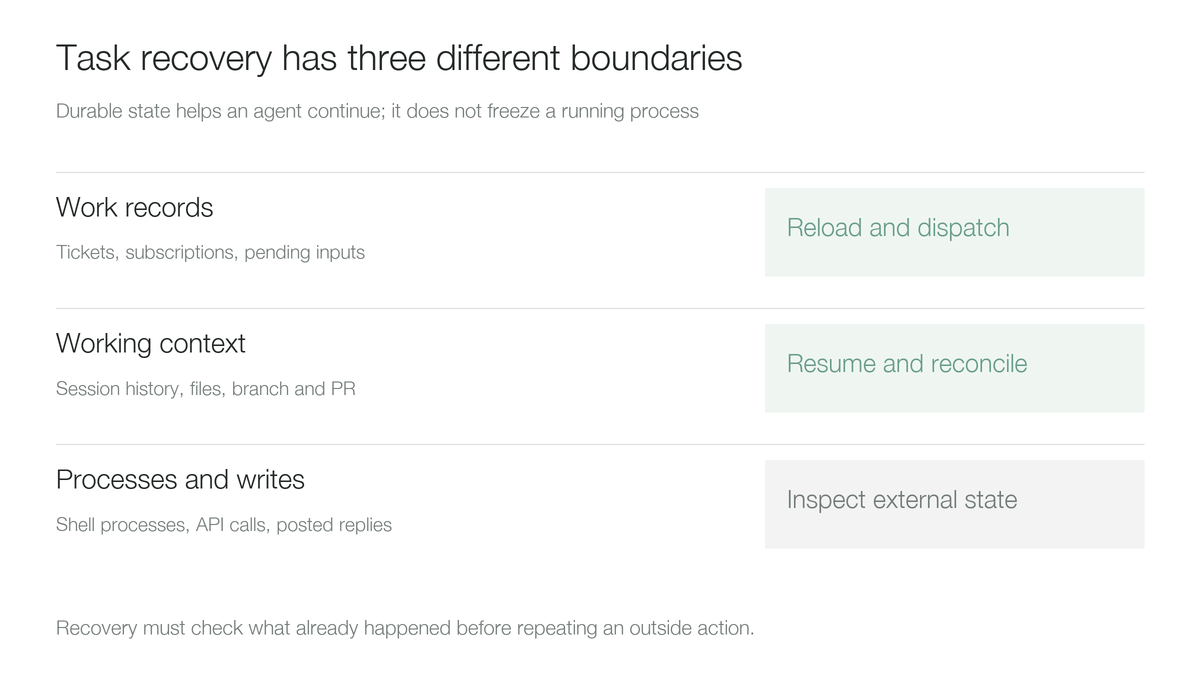
Figure 2: A conceptual recovery boundary. Work records can be dispatched again; sessions and checkouts provide context for continuing work; processes and outside writes need separate reconciliation. This is not a local fault-injection result.
| Layer | Prototype's recovery mechanism | Boundary that still needs checking |
|---|---|---|
| Work and pending records | Persists Tickets, subscriptions, inputs and pending effects | Losing the state directory is not an ordinary process-restart recovery |
| Execution context | Reuses sessions, directories, branches and PRs, with a recovery note | Current files and remote state must still be checked |
| Session input | Stable message identifiers and checks of history and pending inboxes prevent duplicate delivery | Input deduplication does not imply exactly-once execution of all tool effects |
| Outgoing replies | Outbox stores receipts, controls ordering and retries with backoff | Uncertainty remains when the remote write succeeded before the local receipt was recorded |
| Shell and background programs | Work can be scheduled again after retry or restart | Process restart ends the original processes; this is not an in-memory snapshot restore |
In the source, AgentDelivery flushes session persistence after delivery. Outbox records a receipt and enqueues an Effect before sending a message. The latter still has a window between completion of the remote write and persistence of its receipt. I would therefore not describe it as an end-to-end exactly-once guarantee for arbitrary API operations.
The official recovery instructions likewise tell the executor to inspect the directory, Git history and GitHub before repeating an outside action. This is continuation using durable state, rather than resuming a killed command at its previous CPU instruction. Sources: recovery semantics, persistence architecture, input delivery, Outbox implementation
6. Separate the panel from the permission boundary
The prototype has a Web panel integrated into the DeepSeek Harness sidebar, with Overview, Source, Trigger, Eval, Execution and Settings tabs. It prioritizes tasks that need human action, followed by system problems and history. It helps answer whether a decision is needed now and where a task is blocked. Source: panel design
However, task scope in the panel is separate from operating-system isolation. The deployment documentation explicitly states that the main session and executors use danger-full-access and run as the operator's OS user. Command wrappers select the agent account by default; separate directories organize files. An executor may still run programs by absolute path or read that user's home directory.
Consequently:
- A
Mandaterecords and constrains how the system judges work authorization; it does not automatically replace file permissions or a sandbox. - Command wrappers such as
blockedCommandsdo not replace underlying access control. - Prompt instructions to obtain approval before merging do not replace branch protection and review rules.
- Exposing the panel requires additional authentication, access boundaries and auditing. Having a Web UI does not establish complete enterprise multi-tenancy.
I would start with a dedicated OS account or isolated virtual machine containing only credentials for a test repository, then expand access gradually. An office environment containing production cluster administrator credentials does not match the prototype's isolation capabilities. Source: deployment isolation guidance
7. How to begin validation and where enterprise adaptation is needed
7.1 Current installation requirements
| Item | Official prototype requirement |
|---|---|
| Runtime tools | Node.js 22.19+ or 24+, pnpm, Git 2.32+, Python 3.8+ and tmux |
| Harness | Deployment documentation specifies @deepseek-ai/dsh@0.2.1-rc.3; the source declares the compatible range |
| GitHub | A github.com repository, a dedicated agent user account and GitHub Command Line Interface (CLI) 2.48+ |
| GitHub Enterprise Server | Currently unsupported; changing only the hostname is not a completed adaptation |
| GitHub App | Cannot directly serve as the agent identity because the implementation depends on account notifications |
| Feishu | Optional; a separate bot and its command-line configuration |
| Model | A provider configured in Harness; assessment and execution can select different models |
The repository's package version is 0.1.0, with private: true. The documented route builds from source and loads a Bundle. The following is a summary of upstream installation instructions, not a deployment performed for this article. Sources: package.json, installation documentation
npm install -g @deepseek-ai/dsh@0.2.1-rc.3
git clone https://github.com/deepseek-ai/dsh-superagent-prototype.git
cd dsh-superagent-prototype
git checkout 6337fc823ce20251c8de8085948165c81aaa701e
pnpm install
pnpm build
Next, follow the official guide to create a new, dedicated Profile, install the local Bundle, configure dedicated accounts, the state directory and the test repository, and then start the service. The upstream Profile creation command replaces an existing configuration with the same name, so it must not be used for upgrades. Reusing a personal Harness environment is also unwise: this plugin changes process-wide PATH and Git configuration.
7.2 Kubernetes deployment recommendations
The following is a deployment proposal inferred from source constraints; it was not executed for this article:
- Use a separate instance per repository and start with one replica. Runtime locks the state directory and opens SQLite. The same directory is not a highly available control plane that multiple replicas can write concurrently.
- Protect both work state and execution context. PersistentVolumeClaims (PVCs) should cover the planned state directory, Harness sessions and worktrees. Keeping only the database does not restore all context.
- Avoid overlapping writers during updates. Do not simply set replicas to 2 for high availability. First validate old-instance shutdown, volume remount, locking and recovery. Single-replica rescheduling is a recovery mechanism, not uninterrupted high availability.
- Deploy model serving separately. Super-agent's control and tool execution do not require a bound GPU. With a remote model API, GPU capacity belongs to downstream inference planning.
- Add enterprise access and execution isolation. Configure authentication, dedicated credentials, network egress, resource limits and backups. Putting each task into a separate sandbox requires adapting the Executor or execution environment; a Session is not already an isolated Pod.
Teams using GitLab, private GitHub services or another collaboration entry point would need to implement the Source, identity checks, event cursors, context readers and Channel writes. The domain abstractions are useful references, but the built-in gh protocol and account notification logic do not migrate automatically. Sources: Runtime state-directory lock, Source extension guide
8. How to establish whether it helps
I recommend a demonstration repository without production write permissions, with fixed models, input tasks, acceptance tests and budgets. Compare a conventional single-session workflow with Super-agent, increasing task concurrency gradually. The number of simultaneous sessions is not a substitute for delivery quality.
| Observation | An actionable definition |
|---|---|
| Delivery quality | Tasks meeting predetermined acceptance criteria divided by all submitted tasks, retaining failures in the denominator |
| Human attention | Clarification, correction, review and cleanup time per completed task |
| Completion latency | Time from request intake to the first reviewable result, separating queueing and execution |
| Proactive noise | Unwanted would-accept decisions in observe, and unhelpful notifications per task |
| Resume correctness | Whether a control-process restart recovers tasks without duplicate branches, PRs or replies |
| Cost | Model calls, input/output and cached tokens, tools and runtime resources per successful task |
| Constraint enforcement | Whether unauthorized requests, unrelated discussions, malicious quotations and stop controls behave as expected |
Five valuable acceptance scenarios are duplicate event delivery, disabling and restoring a reply channel, restarting the control process during work, changing authorization rules and sending a human correction at full load. Each should reconcile database records, session history, worktrees and actual remote repository state.
In the current public prototype, I find the most useful contribution to be organizing agent input, authorization, task state, execution and delivery into a system with explicit recovery and management semantics. That structure is worth testing for a team coding assistant. Enterprise production use still needs real entry-point adaptation, hard isolation, permission governance and fault validation. Its eventual value should be demonstrated through delivery quality and human time saved.