Kubernetes v1.37 DRA Advanced Trio in Practice: Cross-Driver PCIe Alignment, Consumable Capacity, and Single-GPU Fault Quarantine
In our previous lab Lending an inference GPU overnight with KEDA, Volcano and DRA, we compared exclusive whole-GPU DRA claims against nvidia.com/gpu for tidal borrowing. What actually makes DRA (Dynamic Resource Allocation) transformative for production AI infrastructure, however, is not a new syntax for requesting whole GPUs, but three capabilities matured across Kubernetes 1.35–1.37 that legacy Device Plugins fundamentally cannot express:
- Cross-driver PCIe topology co-scheduling: Binding a GPU from
gpu.example.comand an RDMA NIC fromnet.example.comonto the sameresource.kubernetes.io/pcieRoot, eliminating cross-socket UPI/xGMI detours. - Native Consumable Capacity sharing + queue quotas: Using
allowMultipleAllocations: trueso multiple Pods share one physical GPU by memory and compute slices (each with a distinctShareID), while enforcing queue-level VRAM/compute caps directly in Volcanov1.16.0. - KEP-4680 device health reporting + single-GPU
DeviceTaintRulequarantine: Surfacing GPU overheating or lost-contact faults directly into PodallocatedResourcesStatus, then shrinking the fault blast radius from draining an entire 8-GPU node withkubectl draindown to evicting only the single faulty GPU.
We executed three suites (8 controlled experiments in total) on a local 3-node Kubernetes v1.37.2 cluster (Volcano v1.16.0 + dra-example-driver v0.5.0). Here are the measured results:
- Cross-driver PCIe root alignment (
matchAttribute): Without a constraint, the control Pods1a-unalignedsilently reachedRunningin 1.43 s while mismatched across sockets ontogpu-1(pci0000:80) +nic-0(pci0000:00). AddingmatchAttribute: resource.kubernetes.io/pcieRootyielded 100% same-root pairings across 4/4 Pods. Taintingnic-1held a pinned PodPendingrather than silently mis-pairing across sockets, and removing the taint healed it in 1.48 s. Switching to Volcanov1.16.0also delivered aligned cross-driver pairing in 2.06 s. - Consumable Capacity slicing and Volcano queue VRAM quota: On single GPU
gpu-0(80 GiB memory / 100 compute), three Pods requesting24Gi+30packed cleanly onto the card with 3 distinctShareIDs (72Gi / 80Gi,90 / 100). A 4th Pod (96Gi > 80Gi) and an over-range claim (90Gi > 80Gi) were both blockedPending; deleting Pod 0 let Pod 3 acquire the freed slice in 3.81 s. On Volcanov1.16.0, capping queuedra-vgpu-qatmemory.deviceclass/gpu.example.com: 48Giblocked a 3rd Pod (Queue <dra-vgpu-q> DRA resource insufficient) even with 272 GiB still free on the node; deleting one Pod let it run in 1.91 s. - KEP-4680 reporting boundary and single-GPU self-healing: Injecting an overheat fault on
gpu-1propagated to PodallocatedResourcesStatusasUnhealthyin 1.62 s (Unknownlost-contact propagated in 0.52 s), yet observing for 10 s confirmedkubeletdoes not auto-evict the Pod—KEP-4680 is reporting-only. Applying a single-GPUDeviceTaintRule(NoExecute) targetinggpu-1triggered eviction in 0.86 s; the Deployment's replacement Pod avoided the faulty card, landed on healthy sparegpu-2, and reachedRunning+Healthyin 1.85 s, while the healthy sibling Pod ongpu-0on the same node suffered 0 restarts and kept its original UID.
All workloads in this lab run on simulated DRA GPU/NIC devices provided by
dra-example-driver v0.5.0. The timings measure real Kubernetesv1.37.2and Volcanov1.16.0control-plane topology matching, capacity accounting, CDI injection, health propagation, and eviction self-healing; physical PCIe throughput gains and runtime VRAM hard isolation still depend on vendor DRA drivers and hardware runtimes (MIG, MPS, or RDMA SR-IOV).
Lab Environment and DRA Resource Topology
The testbed is a 3-node Kubernetes v1.37.2 cluster (1 control-plane node + 2 workers). Both DRA drivers were pinned to Worker A so topology and single-GPU packing tests stayed deterministic without multi-node spread noise. Alongside the default scheduler, we ran an isolated Volcano v1.16.0 scheduler pair (dra-volcano + dra-pg-controller):
| Component / Driver | Version / Role | Devices and Topology Published on Worker A |
|---|---|---|
gpu.example.com |
dra-example-driver v0.5.0 (GPU instance) |
4 GPUs (allowMultipleAllocations: true, each memory: 80Gi, compute: 100): gpu-0 / gpu-2 on pci0000:00, gpu-1 / gpu-3 on pci0000:80 |
net.example.com |
dra-example-driver v0.5.0 (NIC instance) |
2 NICs (allowMultipleAllocations: true, each ingressBandwidth: 100G, egressBandwidth: 100G, vfs: 100): nic-0 on pci0000:00, nic-1 on pci0000:80 |
dra-volcano |
Isolated Volcano v1.16.0 scheduler |
Enabled predicate.DynamicResourceAllocationEnable: true, capacity.DynamicResourceAllocationEnable: true, capacity.DRAConsumableCapacityEnable: true |
One practical deployment detail when installing dra-example-driver: if your cluster uses a non-default kubelet root directory instead of /var/lib/kubelet, you must explicitly set kubeletRegistrarDirectoryPath and kubeletPluginsDirectoryPath in Helm values; otherwise the plugin never registers with kubelet and zero ResourceSlice objects appear.
Practice 1: Cross-Driver PCIe Root Topology Alignment (GPU + RDMA NIC)
With traditional Device Plugins, nvidia.com/gpu and rdma/roce_gdr are independent integer counters. The scheduler only knows a node has a free GPU and a free NIC, with no guarantee they sit behind the same CPU PCIe Root Complex. When mismatched, GPUDirect RDMA traffic detours over cross-socket interconnects (UPI/xGMI), introducing subtle tail-latency regressions in multi-node training or disaggregated P/D KV-cache transfers (for whole-GPU NUMA alignment, see For a 4-GPU Task on an 8-GPU Node, How to Avoid Getting Fragmented GPUs Across NUMA).
A DRA ResourceClaimTemplate can request devices from two separate DeviceClass drivers in a single claim and bind them to the same resource.kubernetes.io/pcieRoot via constraints[].matchAttribute:
apiVersion: resource.k8s.io/v1
kind: ResourceClaimTemplate
metadata:
  name: gpu-nic-pcie-aligned
spec:
  spec:
    devices:
      requests:
      - name: gpu
        exactly:
          deviceClassName: gpu.example.com
          capacity:
            requests:
              memory: 80Gi
              compute: "100"
      - name: nic
        exactly:
          deviceClassName: net.example.com
          capacity:
            requests:
              ingressBandwidth: 25G
              egressBandwidth: 25G
              vfs: "1"
      constraints:
      - requests: ["gpu", "nic"]
        matchAttribute: resource.kubernetes.io/pcieRoot
We ran four progressive tests (1A–1D), double-checking both ResourceClaim.status.allocation and the CDI environment variables (GPU_DEVICE_* / NET_DEVICE_*) injected inside each running container:
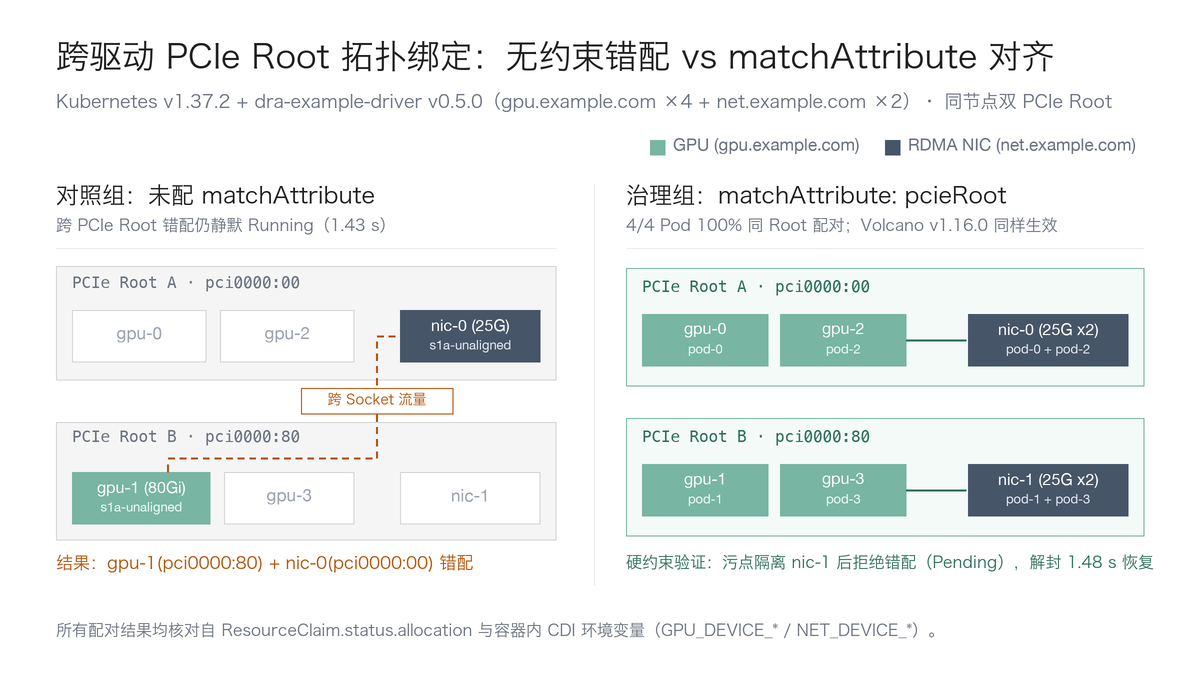
| Experiment | Scheduler & Constraint | Allocated Devices & PCIe Roots | Outcome & Latency | Operational Meaning |
|---|---|---|---|---|
| 1A Control | default-scheduler, no matchAttribute, pinned gpu to gpu-1 and nic to nic-0 |
gpu-1 (pci0000:80) + nic-0 (pci0000:00) |
Running (1.43 s), pcie_matched: false |
Without a constraint, cross-PCIe-root mismatches succeed silently with degraded dataplane performance |
| 1B Full Alignment | default-scheduler + matchAttribute: resource.kubernetes.io/pcieRoot, 4 concurrent Pods |
pod-0: gpu-0+nic-0 (0000:00); pod-1: gpu-1+nic-1 (0000:80); pod-2: gpu-2+nic-0 (0000:00); pod-3: gpu-3+nic-1 (0000:80) |
4/4 Running (1.42 s / 0.07 s / 0.09 s / 0.12 s), 100% same-root matched |
Each 100G NIC automatically serves two 25G × 2 slices for the two GPUs on its own PCIe root |
| 1C Strict Guard | Tainted nic-1 (0000:80) with DeviceTaintRule (NoSchedule), pinned Pod to gpu-1 (0000:80) |
Held Pending (2 cannot allocate all claims); untainting placed it on gpu-1 + nic-1 (0000:80) |
Refused cross-socket fallback; healed to Running in 1.48 s |
matchAttribute is a strict hard constraint and will not silently degrade across sockets |
| 1D Volcano Check | Switched to dra-volcano (Volcano v1.16.0) with the same matchAttribute |
gpu-1 (pci0000:80) + nic-1 (pci0000:80) |
Running (2.06 s), pcie_matched: true |
Volcano v1.16.0 inherits Kubernetes DRA cross-driver topology solving cleanly |
Inspecting CDI environment variables inside s1a-unaligned and s1b-aligned-0 confirmed both independent drivers injected device identity, memory, and bandwidth parameters into the same container:
# s1b-aligned-0 container CDI env (gpu-0 + nic-0, both on pci0000:00)
GPU_DEVICE_0=gpu-0
GPU_DEVICE_0_COMPUTE=100
GPU_DEVICE_0_MEMORY=80Gi
GPU_DEVICE_0_SHARING_STRATEGY=TimeSlicing
NET_DEVICE_0_INGRESS_RATE=25000000000
NET_DEVICE_0_EGRESS_RATE=25000000000
Production pitfall:
matchAttributeperforms exact string equality. If your GPU DRA driver advertisespci0000:00while your RDMA NIC driver advertises0000:00or a custom domain prefix, every Pod withmatchAttributestaysPendingindefinitely. Always inspectkubectl get resourceslices -o yamlfirst to verify both drivers emit identical attribute keys and value formats.
Practice 2: DRA Consumable Capacity Slicing and Volcano Queue VRAM Quotas
Because nvidia.com/gpu only counts whole integer 1 units, fractional GPU sharing traditionally relied on third-party webhooks (such as HAMi or custom device plugins), splitting state across scheduler extensions, node plugins, and quota admission. Kubernetes DRA Consumable Capacity (KEP-5075) brings fractional accounting into the core API:
- Drivers mark devices with
allowMultipleAllocations: trueinResourceSliceand publishrequestPolicy.validRangebounds and step sizes (heregpu-0offers1Gi–80Giin1Gisteps and compute1–100in steps of1). - The scheduler assigns each shared allocation a unique
shareID(UUID) and records exact deductions inResourceClaim.status.allocation.devices.results[].consumedCapacity. - Volcano
v1.16.0'scapacityplugin extends this to queue-level quotas, letting platform teams cap total VRAM and compute per tenant queue inQueue.spec.capabilityusing<capacityName>.deviceclass/<deviceClassName>.
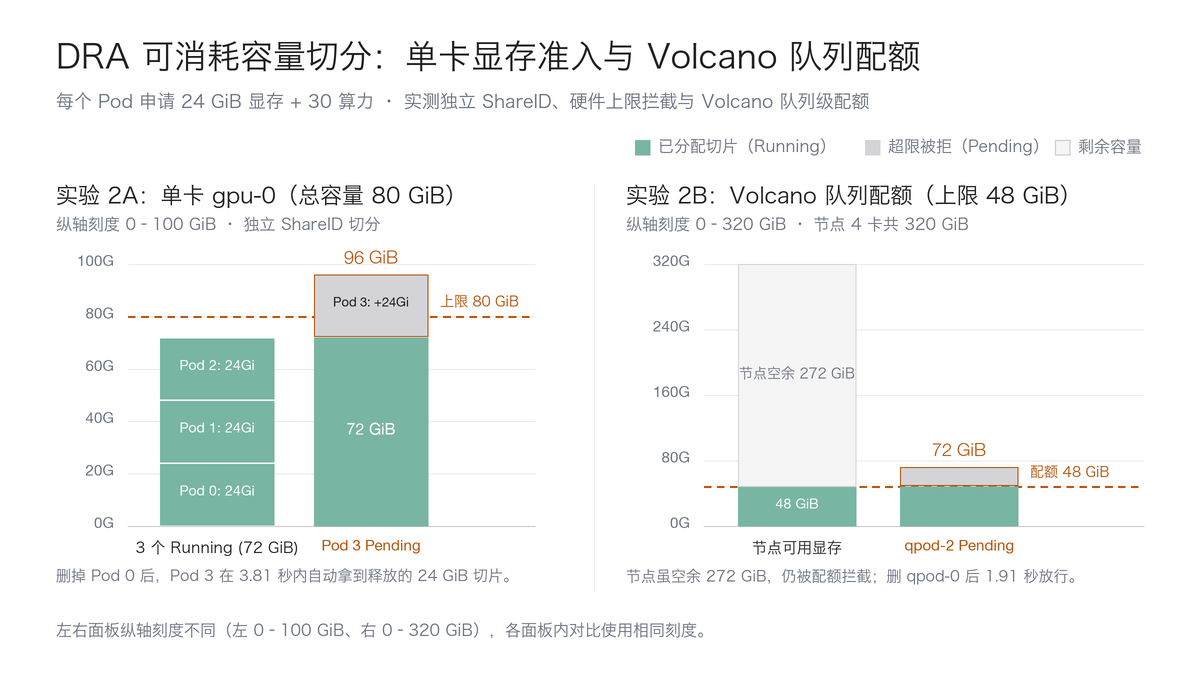
2A. Single-GPU gpu-0 Distinct ShareID Slicing and Hardware Cap Enforcement
Using the CEL selector device.attributes["gpu.example.com"].index == 0, we pinned all test Pods onto gpu-0 (80Gi memory, 100 compute), each requesting 24Gi memory + 30 compute:
| Pod | Requested Capacity | Status & Latency | Assigned shareID (first 8 chars) |
Container CDI Injection |
|---|---|---|---|---|
s2a-slice-0 |
24Gi + 30 |
Running (1.40 s) |
1c426a4c |
GPU_DEVICE_0_MEMORY=24Gi, GPU_DEVICE_0_COMPUTE=30 |
s2a-slice-1 |
24Gi + 30 |
Running (0.07 s) |
21a8516a |
GPU_DEVICE_0_MEMORY=24Gi, GPU_DEVICE_0_COMPUTE=30 |
s2a-slice-2 |
24Gi + 30 |
Running (0.13 s) |
d9e11e1b |
GPU_DEVICE_0_MEMORY=24Gi, GPU_DEVICE_0_COMPUTE=30 |
s2a-slice-3 |
24Gi + 30 (total 96Gi > 80Gi) |
Blocked Pending |
None (cannot allocate all claims) |
— |
s2a-overmax |
90Gi (exceeds validRange.max: 80Gi) |
Blocked Pending |
None (cannot allocate all claims) |
— |
s2a-slice-3 after deleting s2a-slice-0 |
Reclaims freed 24Gi + 30 |
Running in 3.81 s |
054ff523 (fresh ShareID) |
GPU_DEVICE_0_MEMORY=24Gi, GPU_DEVICE_0_COMPUTE=30 |
One subtle observation from the run: at the moment each Pod transitioned to Running, shareID, consumedCapacity inside ResourceClaim.status.allocation.devices.results, and container CDI env vars were all populated immediately, whereas dra-example-driver's ResourceClaim.status.devices array sampled as null. Production accounting and monitoring should therefore read ResourceClaim.status.allocation as the source of truth rather than relying solely on status.devices.
2B. Volcano v1.16.0 Queue-Level VRAM and Compute Quota Enforcement
Device-level caps prevent oversubscribing a single card, but multi-tenant platforms also need to stop a tenant from consuming more than 48 GiB even when 272 GiB remain idle on the node. We created queue dra-vgpu-q in Volcano v1.16.0:
apiVersion: scheduling.volcano.sh/v1beta1
kind: Queue
metadata:
  name: dra-vgpu-q
spec:
  weight: 1
  reclaimable: true
  deserved:
    cpu: "10"
    memory: 16Gi
    memory.deviceclass/gpu.example.com: 48Gi
    compute.deviceclass/gpu.example.com: "60"
  capability:
    cpu: "20"
    memory: 32Gi
    memory.deviceclass/gpu.example.com: 48Gi
    compute.deviceclass/gpu.example.com: "60"
With 4 × 80 GiB GPUs (320 GiB total) available on Worker A, we submitted three 24Gi + 30 Pods to dra-vgpu-q:
s2b-qpod-0(1.83 s) ands2b-qpod-1(0.85 s) reachedRunning, consuming48Gimemory and60compute in the queue;s2b-qpod-2(which would push the queue to72Gi > 48Gi) was heldPendingby Volcano'scapacityplugin despite 272 GiB remaining free on the node;- Deleting
s2b-qpod-0alloweds2b-qpod-2to acquire the freed queue quota and reachRunningin 1.91 s.
The Volcano scheduler logs confirm the rejection came directly from the DRA consumable-capacity ledger rather than node exhaustion:
I1124 11:16:28.049636 1 capacity.go:1709] Queue <dra-vgpu-q> DRA resource insufficient for candidate <s2b-qpod-2>
I1124 11:16:28.049654 1 allocate.go:952] Queue <dra-vgpu-q> is overused when considering task <s2b-qpod-2>, ignore it.
Enforcement boundary: DRA Consumable Capacity governs control-plane scheduling accounting, queue quotas, and CDI parameter delivery. Turning
GPU_DEVICE_0_MEMORY=24Giinto an unbreakable runtime VRAM wall still requires hardware/driver enforcement underneath (such as NVIDIA MIG, MPS memory limits, or vendor vGPU CUDA interceptors).
Practice 3: KEP-4680 Device Health Reporting and Single-GPU DeviceTaintRule Self-Healing
On 8-GPU servers, single-card XID errors, thermal throttling, or PCIe drop-offs happen routinely. Traditional recovery relies on Node Problem Detector tainting the entire node with NoExecute or running kubectl drain, which evicts 7 healthy GPUs' worth of live inference or training jobs just to isolate 1 faulty card.
Kubernetes v1.37 supplies two complementary building blocks:
- KEP-4680 (DRA Device Health): A DRA driver streams per-device health (
Healthy/Unhealthy/Unknown) tokubeletvia gRPCNodeWatchResources, andkubeletwrites it directly intostatus.containerStatuses[].allocatedResourcesStatuson the Pod using that device. DeviceTaintRule(resource.k8s.io/v1alpha3): An operator or watchdog controller can apply aNoScheduleorNoExecutetaint to one specific device (driver+pool+device), letting the control-planeDeviceTaintManagerevict only the Pod bound to that faulty GPU without touching sibling Pods on the same node.
We deployed a 2-replica serving Deployment dra-serving onto Worker A (4 GPUs: gpu-0 through gpu-3). At baseline, the victim replica ran on gpu-1 (53°C, Healthy), the sibling replica ran on gpu-0 (53°C, Healthy), and gpu-2 / gpu-3 stood ready as healthy spares.
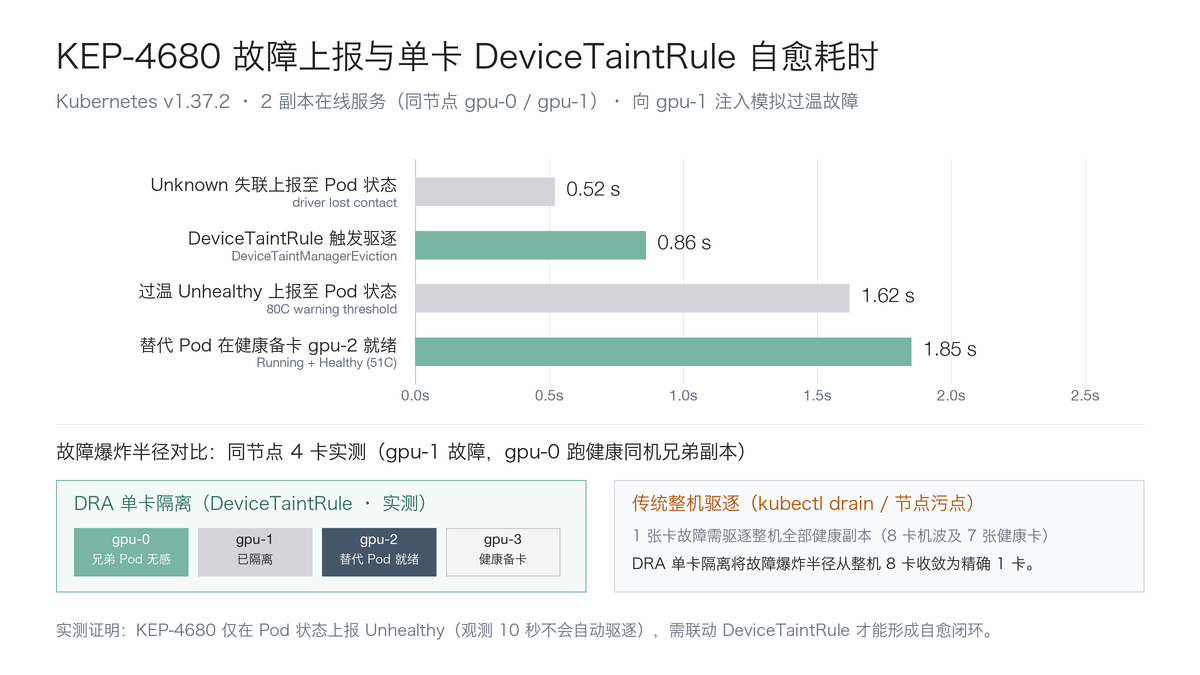
3A. Measuring the KEP-4680 State Machine and kubelet Boundary
We injected simulated overheat and lost-contact faults via annotations health.example.com/gpu-1=unhealthy and unknown on the dra-example-driver Pod, observing status.containerStatuses[0].allocatedResourcesStatus on the victim Pod:
- Overheat
Unhealthypropagation took1.62 s: The Pod status surfaced the exact faulty card and thermal message:
name: claim:gpu
resources:
- health: Unhealthy
  message: "gpu-1 temperature: 80°C (warning threshold exceeded, safe limit is 85°C)"
  resourceID: k8s.gpu.example.com/gpu=common
- Critical boundary test (10 s observation): With no external watchdog active, the victim Pod remained
phase: Runningwithrestarts: 0.kubeletdoes not automatically restart or evict a Pod whenallocatedResourcesStatustransitions toUnhealthy. - Lost-contact
Unknownpropagation took0.52 s: Switching the annotation tohealth.example.com/gpu-1=unknownupdated the Pod status tohealth: Unknown(Health of device gpu-1 cannot be determined (driver lost contact with the device)) in half a second.
This separation is intentional: kubelet cannot know whether a serving workload wants immediate termination or graceful traffic draining first. KEP-4680 standardizes per-device health telemetry in the Pod API, leaving remediation policy to a controller.
3B. Single-GPU DeviceTaintRule Quarantine and 1.85 s Replacement Recovery
Next, acting as a fault watchdog reacting to Unhealthy, we applied a DeviceTaintRule scoped strictly to gpu-1:
apiVersion: resource.k8s.io/v1alpha3
kind: DeviceTaintRule
metadata:
  name: quarantine-gpu-1
spec:
  deviceSelector:
    driver: gpu.example.com
    device: gpu-1
  taint:
    key: health.example.com/gpu-fault
    value: unhealthy
    effect: NoExecute
End-to-end measured results:
| Stage | Measured Timing / State | Verified Evidence |
|---|---|---|
DeviceTaintRule eviction trigger |
0.86 s | Victim Pod (bound to gpu-1) entered deletion with reason DeviceTaintManagerEviction |
| Replacement Pod scheduled & healthy | 1.85 s | New replica avoided tainted gpu-1, landed on healthy spare gpu-2, and reached Running + Healthy (temperature: 51°C) |
| Same-node sibling impact | 0 disruption, 0 restarts | Sibling dra-serving-58f799f5b4-r87vk on gpu-0 kept the exact same UID, restarts: 0, and Healthy (53°C) |
Compared to kubectl drain or node-level taints, single-GPU DeviceTaintRule narrows the blast radius of a single bad GPU from an entire 8-GPU host down to 1 GPU. In production, teams can tier remediation by fault severity:
- Soft faults (thermal warnings, rising correctable ECC): Apply a
DeviceTaintRulewitheffect: NoSchedulefirst to block new placements while draining live inference traffic gracefully before recreating the Pod. - Hard faults (uncorrectable ECC, XID 79 fallen off bus, driver
Unknown): Applyeffect: NoExecute(or shorttolerationSeconds) for second-level failover, then delete theDeviceTaintRuleonce hardware repair and burn-in pass to return the GPU to the pool.
Production Rollout Checklist and Pitfalls
| Capability | Recommended Production Setup | Key Boundaries and Pitfalls to Verify First |
|---|---|---|
| Cross-driver GPU + RDMA NIC alignment | Put both device requests in one ResourceClaimTemplate with matchAttribute: resource.kubernetes.io/pcieRoot |
Both DRA drivers must emit identical pcieRoot attribute keys and value formats; matchAttribute is a hard constraint and holds Pods Pending if same-root NICs are unavailable |
| Fractional GPU sharing & queue quota | Enable allowMultipleAllocations: true in driver; enable capacity.DynamicResourceAllocationEnable and capacity.DRAConsumableCapacityEnable in Volcano v1.16.0 |
Queue quota keys follow <capacity>.deviceclass/<class>; DRA handles scheduling ledger and CDI injection, while runtime VRAM hard isolation still needs MIG/MPS/vGPU |
| Single-GPU fault visibility & self-healing | Run KEP-4680-capable kubelet + DRA driver plus a lightweight watchdog watching allocatedResourcesStatus to reconcile DeviceTaintRule |
KEP-4680 does not auto-evict faulty Pods; DeviceTaintRule currently lives in resource.k8s.io/v1alpha3 (verify the API group is enabled in your cluster) |
Custom kubelet root directory |
Pass kubeletRegistrarDirectoryPath and kubeletPluginsDirectoryPath explicitly when installing DRA drivers |
Mismatched paths silently prevent plugin registration and leave the cluster with zero ResourceSlice objects |
Reproducible Lab Kit and Raw Measurements
All automation scripts, core YAML manifests, and sanitized raw JSON outputs from the three suites are packaged below and can be reproduced and auto-cleaned on any Kubernetes v1.36+ (recommended v1.37+) cluster:
- Reproducible Lab Kit: lab.zip (includes
README.md,pcie-aligned-claim-template.yaml,volcano-dra-queue.yaml,quarantine-device-taint-rule.yaml, andrun_dra_suite.py) - Sanitized Raw Results JSON: results.json (contains every
ShareID, CDI env dump, Volcano scheduler log excerpt,allocatedResourcesStatuspayload, and measured timing)
Further reading: