Lending inference GPUs overnight: declarative reclaim, fragmentation, Gang jobs, and DRA DeviceTaintRule
At ten in the evening, an online model sees light traffic and needs only 4 baseline GPUs instead of its daytime 8. Can the idle 4 GPUs be lent automatically to offline batch inference or distributed training? When a midnight traffic burst hits, how fast do the GPUs come back without custom glue scripts—and what breaks when an offline container hangs, when GPUs fragment across nodes, or when you switch from nvidia.com/gpu to DRA?
We ran five hands-on test suites on a local 3-node Kubernetes v1.37.2 cluster (two 8-GPU workers exposing 16 simulated B300 GPUs plus 4 exclusive DRA example devices) using KEDA v2.21.1, Volcano v1.16.0 multi-queue reclaim, and Kubernetes v1.37 native DeviceTaintRule:
- 16-GPU
nvidia.com/gpudeclarative lending and reclaim (zero custom handoff script): Overnight, an offlinevcjobautomatically borrowed up to 12 GPUs (16/16 GPUs utilized). After injecting 400 burst online requests, KEDA scaled the elastic Deployment and Volcanoreclaimevicted exactly 4 offline Pods while the remaining 8 kept running uninterrupted. Within 13.10 s of enqueue, all 4 elastic replicas were Running and serving; 400/400 online requests completed (252 base, 148 elastic) and 720/720 offline items committed with an execution count of 1 each. - Three real Volcano + KEDA production traps caught live: Volcano's default
overcommitplugin blocked a 4-GPU onlinePodGroupinPendingat 16/16 GPU utilization; the default DeploymentPodGroup(minMember: 1) stoppedreclaimafter 1 GPU; andvcjob's defaultmaxRetry: 3failed the entire offline job (Failed) during a 4-GPU reclaim wave. - Measured DRA
ResourceClaimboundary and Kubernetes v1.37 fix: In Volcano v1.16.0,capacityenforces DRA admission quotas, butreclaimdoes not automatically evict DRA devices (full DRA nodes are filtered out during preemption predicates). On Kubernetes v1.37, applying a nativeDeviceTaintRule (NoExecute)with an offlinetolerationSeconds: 2window handedgpu-1to the waiting online Pod in 5.39 s. - Fragmentation control, Gang jobs, and chaos drills: Volcano
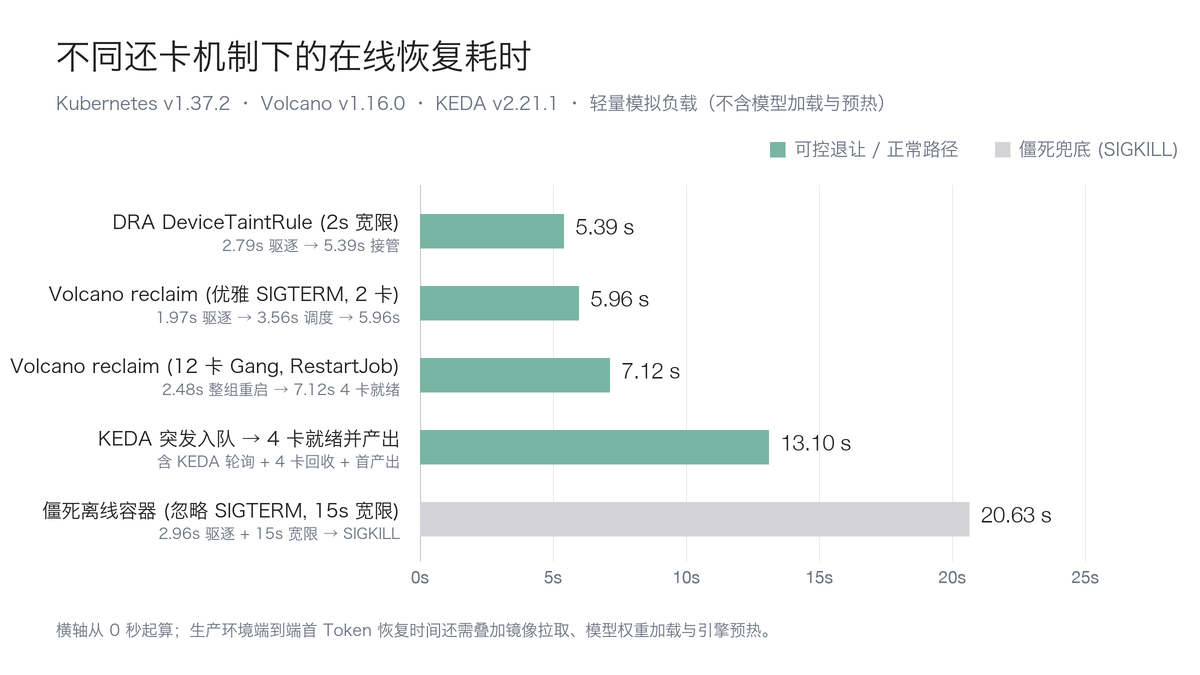
binpackpluspod-deletion-costcleared a full 8-GPU worker so an 8-GPU single-node job started in 5.32 s (versusPendingunder spread with the same 10 free GPUs). A 12-GPU multi-node Gangvcjobshowed 8 zombie GPUs underRestartPodversus clean full release (2.48 s full reset, 4 online GPUs Ready at 7.12 s) underRestartJob. Chaos drills verified a 20.63 s bounded ceiling for a rogueSIGTERM-ignoring worker (terminationGracePeriodSeconds: 15) and exposed two critical blind spots in KEDAfallback.
All workloads in this lab are lightweight synthetic processes. The timings measure control-plane detection, scheduling reclaim, device release, and container startup—production time to first token must also include image pulls, model weight loading, and engine warmup.
Choose what to hand over: engine sleep vs. whole-device lending
| Goal | Mechanism | Cost when demand returns |
|---|---|---|
| Alternate two models in one GPU's VRAM | Coordinate engine sleep/wake inside the owning Pod, keeping its device allocation alive | Restore weights, rebuild KV cache, verify free VRAM |
| Lend a whole exclusive GPU to another Kubernetes Job | Scale elastic serving replicas to zero and reclaim via Volcano multi-queue reclaim or DRA DeviceTaintRule |
Wait for offline checkpoint/exit, device deallocation, Pod startup, and model warmup |
| Serve latency-sensitive traffic overnight | Isolate always-on base replicas outside KEDA with Volcano guarantee, lending only elastic replicas |
Base replicas absorb initial burst queuing until elastic replicas warm up |
vLLM level-1 sleep offloads weights to host memory and drops the KV cache, while level-2 also discards model parameters; SGLang exposes memory release and resume endpoints. These calls change only in-process VRAM usage. In our control probe, pausing the online worker while keeping its Pod alive left the exclusive ResourceClaim locked across two observations 9.75 s apart, keeping a competing offline Pod Pending. For multi-model coexistence on one physical GPU, see our earlier L20 study. vLLM Sleep Mode · SGLang memory release and resume · AIBrix on one L20
Whenever overnight borrowers are independent batch or training Jobs, the elastic online Pods must terminate to return whole GPUs—and the cluster needs a declarative path to reclaim them under burst traffic.
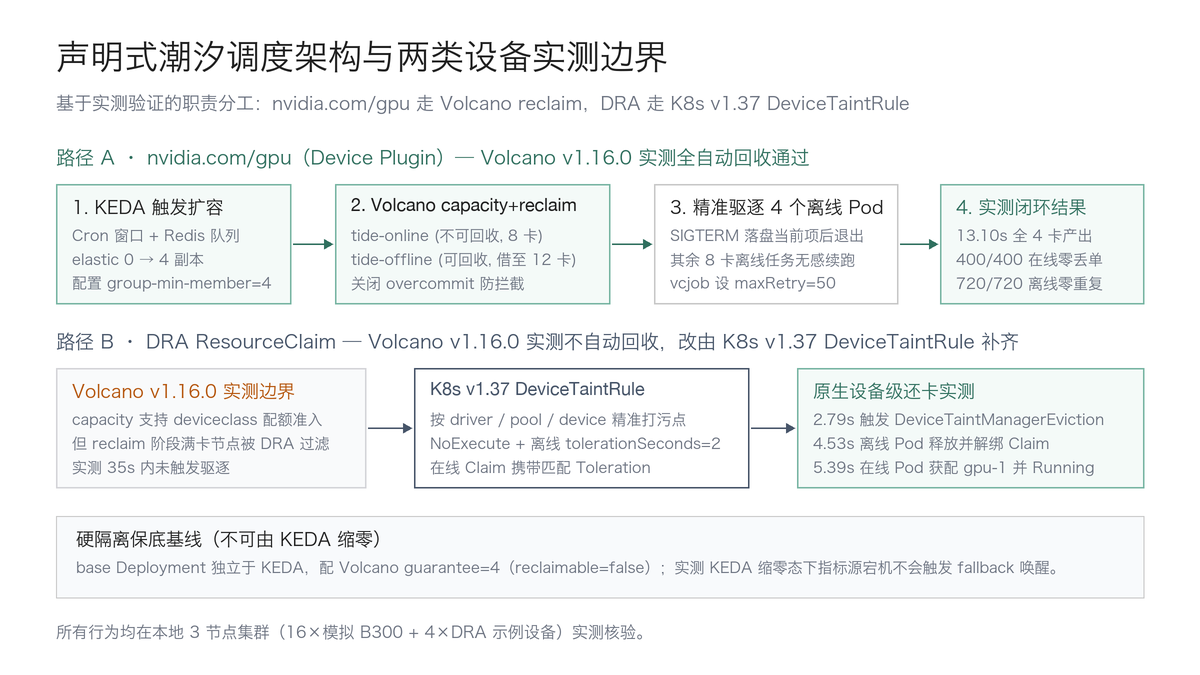
Lab topology and declarative queue setup
The cluster runs Kubernetes v1.37.2 across 1 control-plane node and 2 workers (Worker A, Worker B) with two device pools:
- 16 simulated B300 GPUs (
nvidia.com/gpu):fake-gpu-operatorv0.2.1 advertises 8NVIDIA-B300-SXM6-ACdevices per worker for multi-queue reclaim, fragmentation control, 12-GPU Gang jobs, rogue-worker drills, and KEDA outage drills. - 4 exclusive DRA devices (
gpu.example.com):dra-example-driverv0.5.0 advertisesgpu-0throughgpu-3onWorker Afor Volcano DRA reclaim testing and Kubernetes v1.37DeviceTaintRule.
In volcano-system, we ran an isolated Volcano scheduler (tide-volcano) and PodGroup controller (tide-pg-controller with --controllers=pg-controller --scheduler-name=tide-volcano) alongside two queues:
tide-online:reclaimable: false,guarantee: 4 GPU / 1 DRA,deserved: 8 GPU / 2 DRA,capability: 16 GPU / 4 DRA,PriorityClass: tide-online-high (1000).tide-offline:reclaimable: true,guarantee: 0,deserved: 8 GPU / 2 DRA,capability: 16 GPU / 4 DRA,PriorityClass: tide-offline-low (100).
Because tide-online reserves guarantee: 4, Volcano's capacity plugin automatically caps tide-offline's realCapability at 16 - 4 = 12 GPUs—offline jobs can borrow up to 12 GPUs without ever encroaching on the 4 baseline GPUs, while any allocation above deserved: 8 remains immediately reclaimable by tide-online.
# Verified tide-volcano scheduler config after fixing production pitfalls
actions: "enqueue, allocate, backfill, reclaim, preempt"
tiers:
- plugins:
  - name: priority
  - name: gang
    enablePreemptable: false
    enableReclaimable: false   # allow reclaiming minAvailable == replicas Gang jobs
  - name: conformance
- plugins:
  # Intentionally omit default overcommit plugin so 16/16 full utilization does not block enqueue
  - name: drf
    enablePreemptable: true
    enableReclaimable: true
  - name: predicates
    arguments:
      predicate.DynamicResourceAllocationEnable: true
  - name: capacity
    arguments:
      capacity.DynamicResourceAllocationEnable: true
      capacity.DRAConsumableCapacityEnable: true
  - name: nodeorder
  - name: binpack
    arguments:
      binpack.weight: 10
      binpack.resources: nvidia.com/gpu
      binpack.resources.nvidia.com/gpu: 10
Trial 1: 16-GPU declarative multi-queue reclaim (nvidia.com/gpu vs. DRA)
1A. 16-GPU nvidia.com/gpu: full automation with zero custom handoff script
Online serving splits into base (fixed 4 replicas outside KEDA) and elastic (KEDA ScaledObject scaling 0–4 via a daytime Cron window plus a Redis list backlog trigger). Offline work is a 12-replica Volcano vcjob (batch-elastic, minAvailable: 1, maxRetry: 50, PodEvicted -> RestartPod) processing 720 items; each worker traps SIGTERM, commits its in-flight item to Redis, and exits cleanly (exit 0).
| Observation (UTC) | Cluster state | Measured outcome |
|---|---|---|
| 06:57:53 | Daytime steady state: base=4, elastic=4, offline=8 (4 Pending) |
16/16 GPUs utilized; offline fills the remaining 8 GPUs |
| 06:59:13 | Cron daytime window ends; KEDA scales elastic to 0 |
Only the 4 baseline GPUs remain online |
| 06:59:19 | Offline scales to 12 Running (0 Pending) |
4 freed GPUs borrowed in ~6 s (tide-offline reaches 12 > deserved 8) |
| 06:59:34.6 | 400 burst online requests enqueued in Redis | Queue spikes; base absorbs initial load |
| 06:59:42.8 | +8.2 s: KEDA scales elastic=4; Volcano evicts 4 offline Pods |
worker-4/5/6/7 checkpoint on SIGTERM and exit; 8 other offline Pods keep running |
| 06:59:47.7 | +13.1 s: All 4 elastic Pods Running and already serving 25 replies |
Zero custom controller logic; 13.1 s from enqueue to all 4 elastic GPUs serving |
| 07:00:05.5 | +30.9 s: All 400 online requests completed | base: 252, elastic: 148, zero drops |
| 07:00:15.0 | +40.4 s: KEDA cooldown scales elastic to 0; all 720 offline items done |
Every offline ID has execution count 1 (zero duplicates, zero loss) |
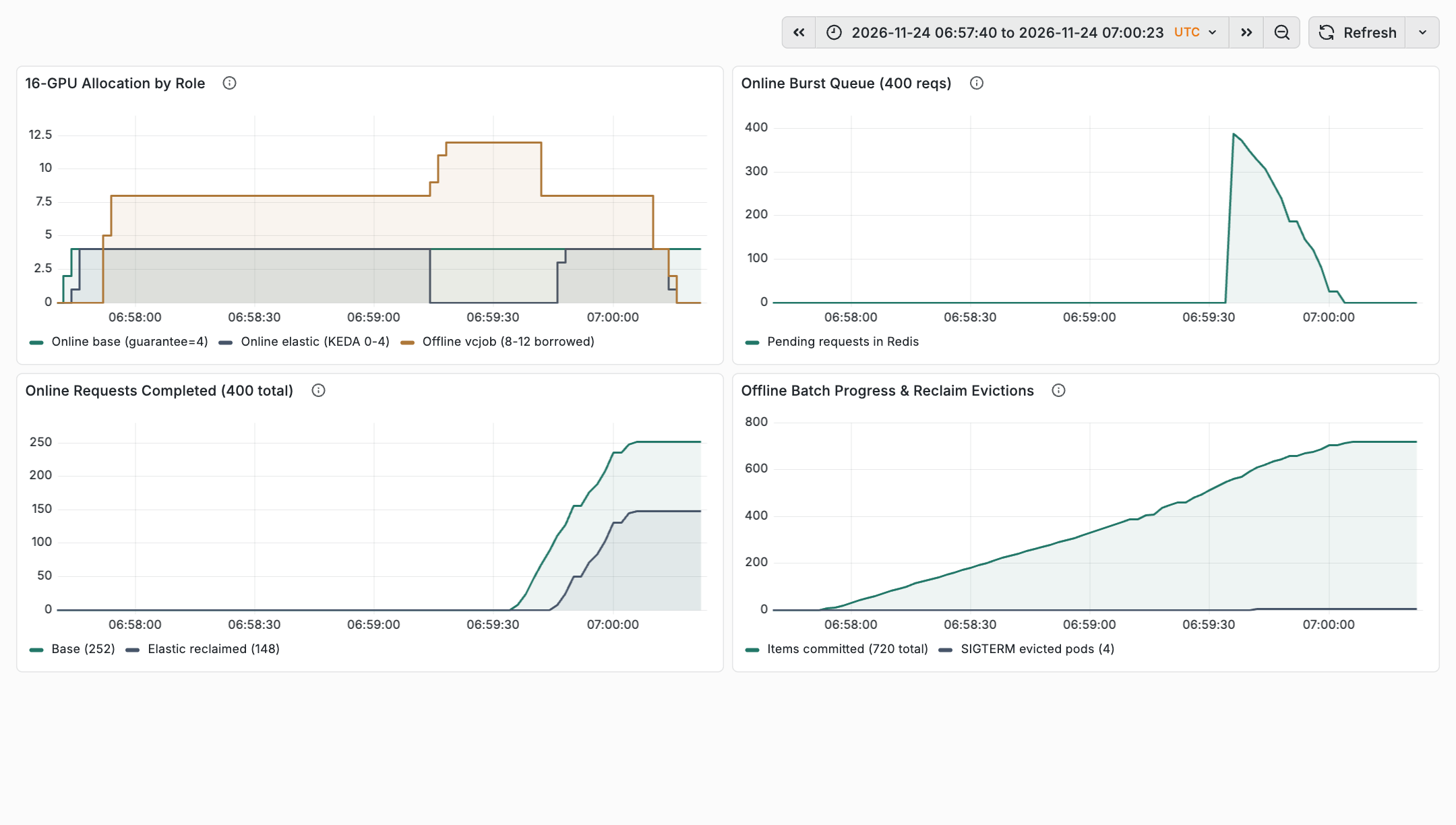
Captured from real Grafana (light theme) by replaying all 86 timestamped cluster and Redis samples into Prometheus. Upper-left shows total allocation holding tightly at 16 GPUs across phases; lower-right shows offline progress climbing continuously to 720/720 across 4 graceful SIGTERM evictions. Sample CSV · Consolidated verification JSON
Three real Volcano + KEDA production traps caught during Trial 1A
Before Trial 1A succeeded end-to-end, we hit and isolated three silent failure modes directly from scheduler logs:
- Trap 1:
overcommitblocksreclaimat 100% GPU utilization. Volcano's default Helm config enablesovercommitwith factor1.2. On a full 16-GPU cluster (limit19.2), a 4-GPU elasticPodGroup(16 + 4 = 20 > 19.2) was rejected atenqueue(overcommit.go:129: Resource in cluster is overused, reject job ... to be inqueue). Because thePodGroupstayedPending,reclaim.go:73skipped it altogether. Fix: removeovercommitoncapacity + reclaimschedulers and letcapacityenforce queue limits. - Trap 2: Default Deployment
PodGroup(minMember=1)stopsreclaimafter 1 GPU. Volcano'spg-controllercreates onePodGroupperReplicaSetwith defaultminMember: 1. Becausereclaim.go:91triggers only whileJobStarving (waiting + ready < minMember)is true, scalingelastic0 -> 4reclaimed only the first GPU, flippedJobStarvingtofalse, and loggedNo preemptors in Queue <tide-online>, break., leaving replicas 2–4 stuckPending. Fix: setscheduling.volcano.sh/group-min-member: "4"on fixed-step elastic Deployments, or split variable-step elastic capacity into separate 1-replica Deployments (or syncminMemberdynamically). - Trap 3:
vcjobdefaultmaxRetry=3kills the offline job on a 4-GPU reclaim wave. EveryPodEvicted -> RestartPodincrementsvcjob.status.retryCount. Reclaiming 4 pods at once trippedretryCount=3 -> Failed, marking the entirevcjobFailedand terminating the other 8 healthy offline Pods. Fix: set an explicitspec.maxRetryheadroom (such as50) on reclaimable batchvcjobs.
1B. DRA ResourceClaim under the exact same setup: Volcano v1.16.0 does not reclaim
Using the same tide-volcano scheduler and queues (with both predicate.DynamicResourceAllocationEnable: true and capacity.DynamicResourceAllocationEnable: true, plus deviceclass/gpu.example.com capability/deserved/guarantee configured per Volcano's DRA quota guide), we tested the 4 DRA devices:
- Nighttime steady state:
dra-baseheldgpu-0;dra-batch(tide-offline) borrowedgpu-1,gpu-2,gpu-3(3 > deserved 2, 4/4 DRA devices full). - Trigger: scaled
dra-elastic(tide-online,deserved: 2) from0 -> 1and observed for 35 seconds. - Measured outcome:
reclaimed_automatically = false, 0 evictions, anddra-elasticstayedPending.
The -v=4 tide-volcano logs pinpointed two causes:
1. Full DRA nodes are eliminated before victim selection: reclaim.go:183 runs PredicateForPreemptAction before tentative eviction, where DynamicResources fails Worker A with cannot allocate all claims, removing the node before reclaim inspects candidate victims.
2. capacity reclaim dimensions exclude DRA: capacity.go:686 logged Queue <tide-online> can reclaim on resource dimensions: [cpu memory]. In addition, totalResource sums Node.Status.Allocatable (which omits DRA devices), clamping tide-online's scalar deserved for deviceclass/gpu.example.com down to its guarantee of 1.
Takeaway: In Volcano v1.16.0,
deviceclass/<DeviceClass>works for queue admission quota, not yet for automated cross-queue DRAreclaim. On DRA-based clusters, pair quota with Kubernetes v1.37's nativeDeviceTaintRule(Trial 4C below).
Trial 2: 16-GPU fragmentation governance and 12-GPU Gang vcjob reclaim
2A. Why 10 free GPUs cannot fit an 8-GPU single-node job
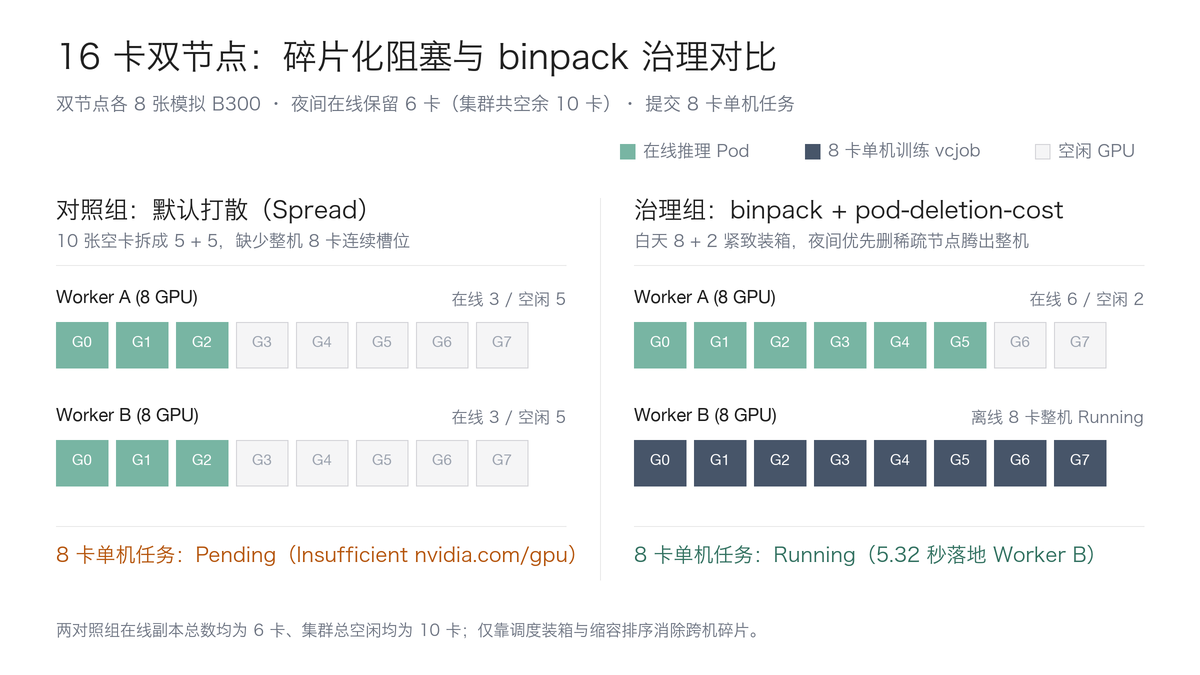
With 6 online GPUs kept overnight across two 8-GPU workers (10 GPUs free cluster-wide), we submitted one 8-GPU single-node vcjob (representing intra-node NVLink training):
- Control (Default spread): Online replicas split 3 + 3 across
Worker AandWorker B, leaving 5 + 5 free. The 8-GPUvcjobstayedPending(0/3 nodes are unavailable: 3 Insufficient nvidia.com/gpu). - Governed (
binpack+pod-deletion-cost): Daytime 10 online replicas packed 8 onWorker A+ 2 onWorker Bvia Volcanobinpack. Annotatingcontroller.kubernetes.io/pod-deletion-cost("100"on fullerWorker A,"-100"on sparseWorker B) before scaling10 -> 6drainedWorker Bfirst, leaving 6 onWorker A+ 0 on Worker B (8 contiguous free GPUs onWorker B). The exact same 8-GPU single-nodevcjobreachedRunningonWorker Bin 5.32 s.
2B. 12-GPU multi-node Gang vcjob reclaim: RestartPod vs. RestartJob
Distributed training requires all ranks to synchronize at barriers. We deployed a 12-GPU multi-node Gang vcjob (minAvailable: 12, spanning 4 GPUs on Worker A + 8 GPUs on Worker B, synchronizing epochs via a 12-rank Redis barrier) and triggered a 4-GPU online elastic burst:
Prerequisite: In the
gangplugin,gang.enableReclaimable: truecausesgang.go:113to refuse evicting any Pod onceready <= minAvailable. SetenableReclaimable: falseon thegangplugin so online queues can reclaim full-width offline Gang jobs.
| Policy | Time to 4 elastic GPUs Running | Offline GPUs held during burst | Training progress | Post-burst recovery |
|---|---|---|---|---|
PodEvicted -> RestartPod (anti-pattern) |
7.13 s | 8 zombie GPUs deadlocked (gang_running=8, pending=4) |
Frozen at epoch 4 waiting at 12-rank barrier | No clean group reset |
PodEvicted -> RestartJob |
7.12 s | All 12 released cleanly at 2.48 s (gang_running=0); watch backfill |
Clean restart triggered across all 12 ranks | Resumed from checkpoint to epoch 10/10 in 18.60 s |
Trial 2B uncovered a subtle scheduler interaction: RestartJob cleanly terminated all 12 ranks at t+2.48 s (gang_running=0, gang_pending=12), freeing the cluster for online reclaim under RestartJob. However, once vcjob recreated the 12 Pods, tide-volcano's backfill action still backfilled 8 of the recreated Pods onto the 8 remaining idle GPUs during the burst (vcjob stayed Pending until online scaled back down and released the final 4 GPUs). For strict all-or-nothing Gang training, either disable backfill on the Gang scheduler or use TerminateJob with an external requeuing layer (such as Kueue).
Trial 3: Production chaos drills
4A. Rogue offline container ignoring SIGTERM: bounding worst-case SLA
In production, offline containers can hang on NCCL or checkpoint I/O, or ignore SIGTERM completely. With terminationGracePeriodSeconds: 15 on both runs and elastic scaling 0 -> 2 on a full 16-GPU cluster:
- Graceful
SIGTERMexit: Eviction seen at1.97 s-> Scheduled at3.56 s-> 2 elastic PodsRunningin5.96 s. - Rogue worker (
trap '' TERM INT, ignoringSIGTERM): Eviction seen at2.96 s-> kubelet waits the full 15 s grace period and sendsSIGKILL-> Scheduled at19.16 s-> 2 elastic PodsRunningin20.63 s(an exact+14.67 sbounded penalty).
Takeaway: Enforce a strict maximum terminationGracePeriodSeconds on tide-offline Pods via admission policy (Kyverno / ValidatingAdmissionPolicy) so a hung container turns into a deterministic SLA ceiling rather than an unbounded stall.
4B. Metric-source outage: two real blind spots in KEDA fallback
Scaling tide-redis to 0 on KEDA v2.21.1 with ScaledObject fallback: {failureThreshold: 2, replicas: 2} revealed two critical limitations:
- Scale-to-zero blind spot (
Active=False): Whenelasticwas already at0, takingtide-redisdown moved theScaledObjecttoReady=False, Active=Unknown, Fallback=Unknownover 51 s—KEDAfallbacknever wokeelasticfrom0to2. - Scaler-init blind spot: Even with
elasticactively serving at4replicas (Active=True), killingtide-redisfailed insidescalers_builder.go:96(TCP dial error while building the Redis scaler cache beforeGetMetricsAndActivity), sofallbacknever incremented (FallbackstayedFalse); when Redis recovered empty, KEDA immediately scaled4 -> 0.
Guardrail: Never rely on KEDA fallback as your baseline availability net. Keep base replicas in a separate Deployment outside KEDA, protected by Volcano guarantee and reclaimable: false.
4C. Kubernetes v1.37 native DRA DeviceTaintRule: 5.39 s device recall
To bridge the Volcano v1.16.0 DRA reclaim gap for DRA ResourceClaims from Trial 1B, we tested Kubernetes v1.37's GA DeviceTaintRule (resource.k8s.io/v1):
- The offline Pod held
gpu-1with a Claim toleration carryingtolerationSeconds: 2fortide.aik8s.io/reclaim=online-only:NoExecute. - The waiting online Pod carried permanent
NoExecuteandNoScheduletolerations and waitedPendingwhilegpu-1was busy. - Applying a
DeviceTaintRule (effect: NoExecute)targetingdriver: gpu.example.com, device: gpu-1: t + 2.79 s:DeviceTaintManagerEviction: Marking for deletionfired right after the 2 s toleration window.t + 4.53 s: The offline Pod completed itsSIGTERMtrap and exited, auto-deallocating itsResourceClaimwhile blocking untolerated offline re-entry ongpu-1.t + 5.39 s: The waiting online Pod claimedgpu-1and enteredRunning.
Kubelet path pitfall: on clusters using a nonstandard kubelet root, both
kubeletPlugin.kubeletRegistrarDirectoryPathandkubeletPlugin.kubeletPluginsDirectoryPathmust point to the actual kubelet root when installing the DRA driver—otherwise pods schedule and receive claims underDeviceTaintRule, then stall onFailedPrepareDynamicResources: DRA driver ... is not registered.
Reproducing the lab and production checklist
Download the sanitized lab kit, containing the verified tide-volcano scheduler ConfigMap, tide-online/tide-offline Queues and PriorityClass manifests, the Kubernetes v1.37 DeviceTaintRule manifest, all three experiment runners, and the light-theme Grafana dashboard JSON.
export LAB_CONTEXT=your-test-context
# 1. Apply queues, PriorityClasses, and isolated tide-volcano / tide-pg-controller
kubectl --context "$LAB_CONTEXT" apply -f volcano-scheduler-cm.yaml -f queues-and-priorities.yaml
# 2. Run all three test suites
python3 exp1_multiqueue_reclaim.py
python3 exp2_gang_and_fragmentation.py
python3 exp3_chaos_drills.py
Before rolling out tidal GPU sharing in production, check six items:
- Isolate baseline serving: Keep
baseoutside KEDA scale-to-zero and reserve its GPUs with Volcanoguaranteeandreclaimable: false. - Audit
overcommitandgroup-min-member: If an onlinePodGroupsitsPendingon a full cluster, check scheduler logs forovercommit.gorejections and verifyPodGroup.spec.minMemberis not stuck at1. - Raise
vcjobspec.maxRetry: Size retry headroom above your worst-case reclaim wave so batch jobs survive multi-GPU reclamation without turningFailed. - Prevent cross-node fragmentation: Enable
nvidia.com/gpu-weightedbinpackfor online serving and setcontroller.kubernetes.io/pod-deletion-costso scale-downs empty sparse nodes first. - Cap offline grace periods: Enforce an upper bound on
terminationGracePeriodSecondsfortide-offlinevia admission policy to bound recovery SLA against hung containers. - Match mechanism to device stack: Today,
nvidia.com/gpu+ Volcanocapacity/reclaimis the most mature declarative stack for automated tidal lending; on Kubernetes v1.37+ DRA clusters, pair DRA quotas withDeviceTaintRule (NoExecute)for eviction, and always budget real model cold-start and warmup time on top of these control-plane numbers.