Jailer and security baseline
The launcher Pod is useful for qualification but is privileged host-management
code. The security experiment therefore also launched a native microVM through
the matching Firecracker jailer binary and inspected the host process after
InstanceStart.
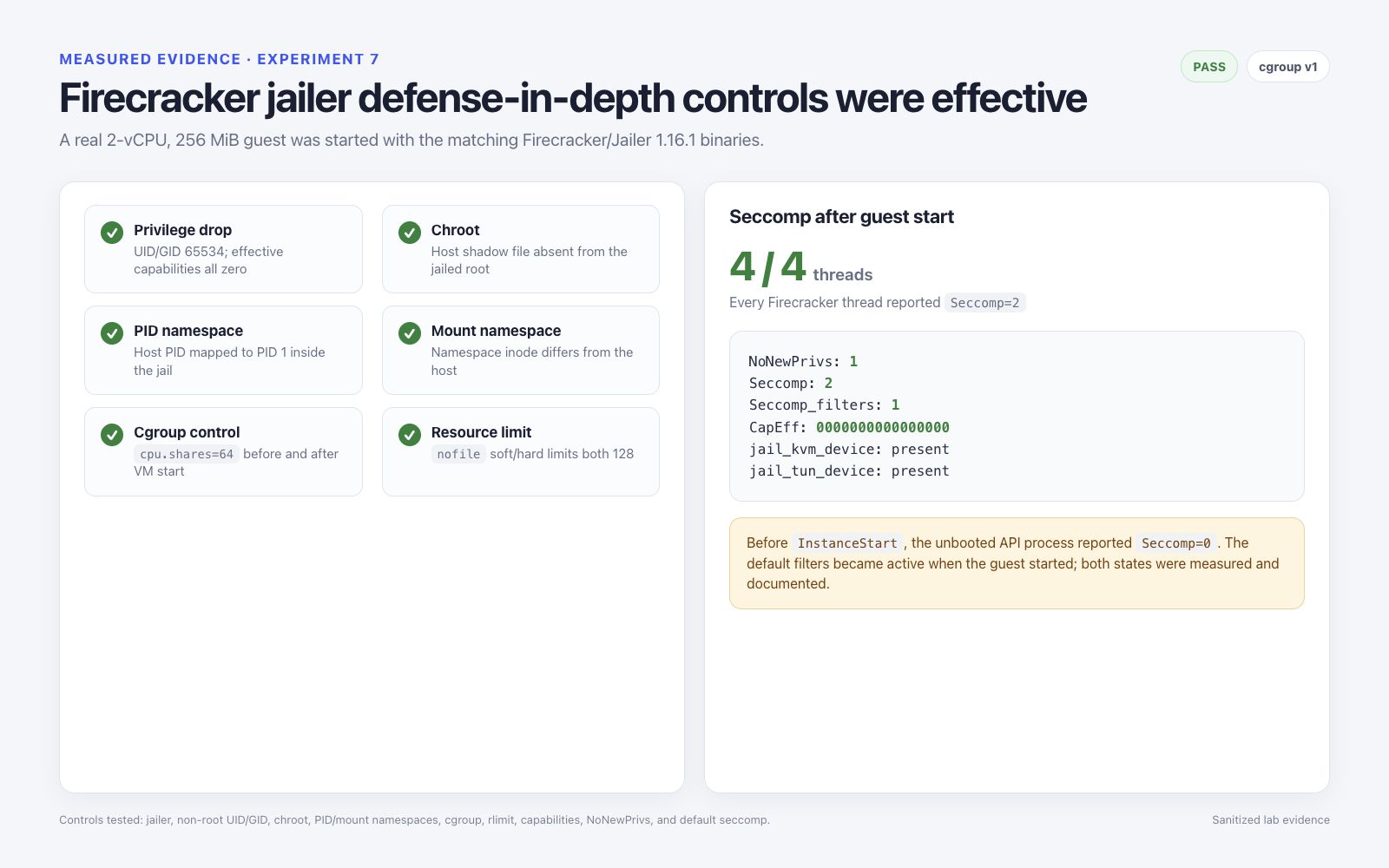
Verified baseline
| Control | Observed result |
|---|---|
| Version pairing | Firecracker 1.16.1 and jailer 1.16.1 |
| Identity | Dedicated UID/GID 65534 |
| Filesystem | Per-instance chroot; host /etc/shadow absent |
| PID namespace | Host VMM PID mapped to PID 1 inside its namespace |
| Mount namespace | Distinct from the host namespace |
| Devices | Only deliberate /dev/kvm and /dev/net/tun device nodes in the jail |
| Capabilities | Effective capability mask zero |
| Privilege escalation | NoNewPrivs=1 after VM start |
| Seccomp | All four VMM threads reported filter mode 2 after VM start |
| Cgroup v1 | CPU shares remained 64 across startup |
| File descriptors | Soft and hard nofile limit 128 |
| Guest | Running with 2 vCPU and 256 MiB |
Before InstanceStart, the API process showed seccomp mode 0. After startup,
all four VMM threads showed seccomp mode 2 with one installed filter. Security
checks must therefore inspect the post-start VMM, not infer the final posture
from the preboot API process.

Deployment requirements
- Pin and verify a matching Firecracker/jailer pair.
- Use one unprivileged identity and one non-reused chroot per instance.
- Make kernel, rootfs, and configuration inputs immutable to the jail UID.
- Create only the device nodes required by the selected VM configuration.
- Set explicit cgroup, rlimit, NUMA, CPU, memory, network, and cleanup policy.
- Authenticate and restrict access to the Firecracker API socket.
- Treat TAP creation, image staging, jail construction, and cleanup as privileged control-plane operations with an audit trail.
- Verify the effective process after start: namespaces, capabilities,
NoNewPrivs, seccomp mode, cgroup membership, open descriptors, and mounts.
The test instance is intentionally retained on the dedicated lab node for follow-up work. That is acceptable for an isolated experiment, but production controllers must guarantee teardown after normal exit, API failure, VMM crash, node reboot, and interrupted creation.
Limits of this result
This smoke test confirms that the documented isolation controls became active; it is not a penetration test or proof of multi-tenant safety. Guest escape, malicious block images, device emulation, kernel attack surface, host service access, and cleanup races require separate adversarial testing.